
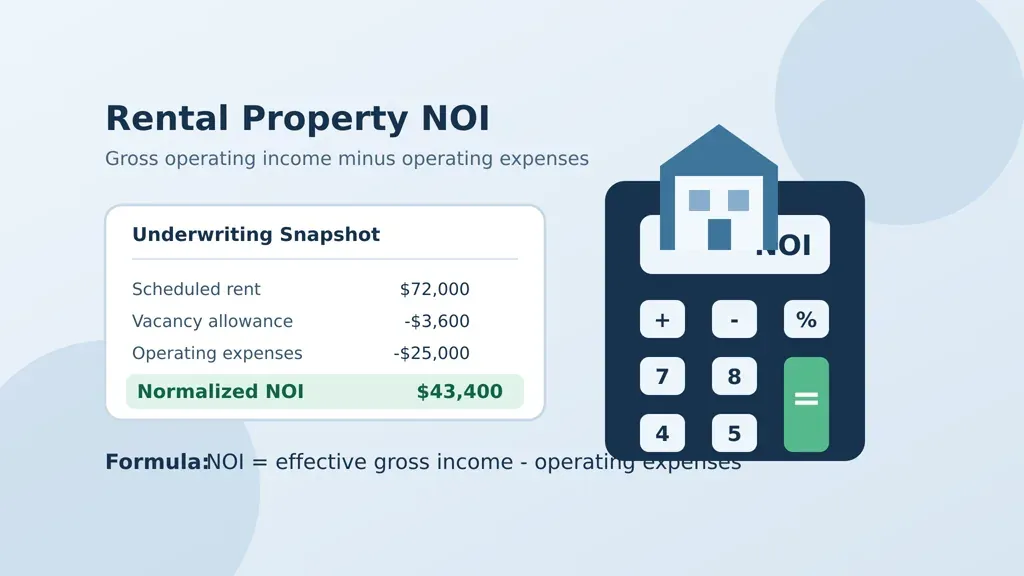
If you are comparing rental deals, refinancing a property, or deciding whether a portfolio is producing enough operating income, you need to know how to calculate NOI for rental property. Net operating income, or NOI, shows the income a property generates before debt service, income taxes, depreciation, amortization, and capital expenditures. It gives investors a cleaner way to compare property operations without letting loan structure hide the underlying performance.
Need cleaner property-level reporting before you underwrite the next deal? Request a consultation with DMR Consulting Group to discuss accounting and advisory support for your real estate portfolio.
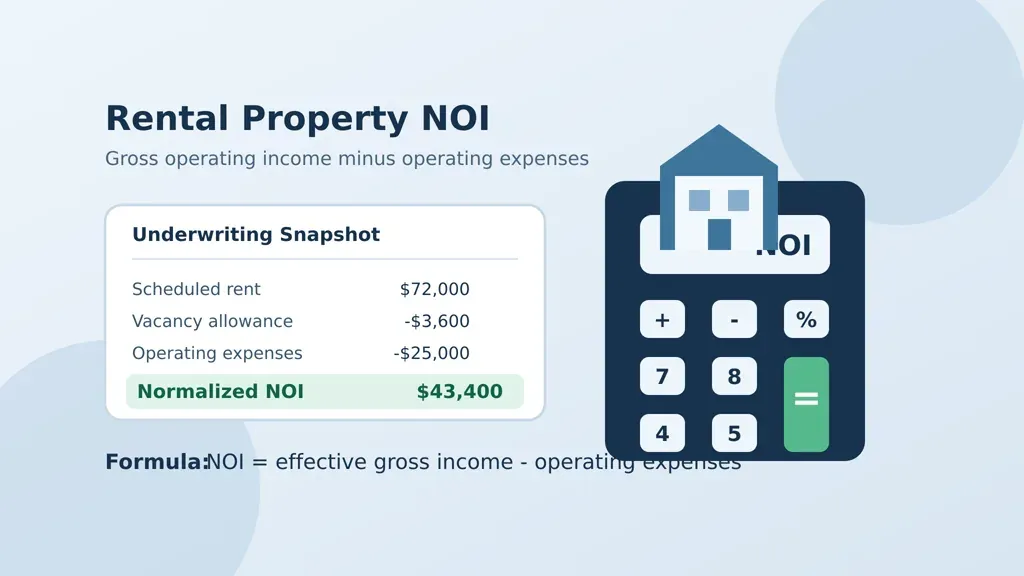
At a glance, the formula looks simple. In practice, NOI becomes useful only when income and expenses are classified consistently, unusual items are normalized, and assumptions reflect the way the property is likely to operate after acquisition. That is why experienced investors treat NOI as both a calculation and an underwriting discipline.
What Is NOI for a Rental Property?
NOI is the rental property’s operating income after ordinary operating expenses are deducted. It is not the same as cash flow. Cash flow considers financing and other ownership decisions. NOI stays focused on property operations.
A rental property can have strong NOI but weak cash flow if the loan payment is high. It can also show positive cash flow in a short snapshot while the underlying NOI is overstated because repairs, vacancy, or management costs were ignored. Investors use NOI to separate operating quality from capital structure.
For rental property analysis, NOI helps answer questions such as:
- How much operating income does the property produce before financing?
- Which deal has stronger economics when two properties use different loan terms?
- Does the seller’s stated income hold up after reasonable expense assumptions?
- How might the property’s value change when cap rates are applied?
- Is the portfolio reporting clean enough for better decision making?
Investors who need portfolio-level visibility also benefit from structured reporting. DMR’s guide to real estate portfolio management accounting explains why isolated property numbers should roll into a broader management view.
The Rental Property NOI Formula
The core calculation is:
NOI = Effective Gross Income – Operating Expenses
Effective gross income is the amount the property is expected to collect after reducing potential rent for vacancy and collection loss, then adding recurring ancillary income. Operating expenses are the recurring costs required to keep the property operating and rentable.
| Component | Typical treatment in NOI |
|---|---|
| Scheduled rent | Included as income |
| Vacancy and credit loss | Subtracted to reach effective gross income |
| Parking, laundry, pet, or storage income | Included when recurring and supportable |
| Property taxes, insurance, utilities paid by owner | Included as operating expenses |
| Repairs, maintenance, landscaping, management | Included as operating expenses |
| Mortgage principal and interest | Excluded |
| Income taxes, depreciation, amortization | Excluded |
| Capital improvements | Excluded from NOI, but reviewed separately |
This distinction matters. NOI is meant to evaluate recurring operations. A new roof, lender origination fee, or owner’s income tax bill may affect the investment, but those items do not describe routine property operations in the same way insurance, taxes, or maintenance do.
How Do You Calculate NOI Step by Step?
A defensible NOI calculation uses five steps. The math can fit on one spreadsheet tab, but the judgment behind each line determines whether the result is useful.
1. Start with gross potential rental income
Gross potential rent is the rent the property could collect if every unit or rentable space were occupied for the period under review. For a single-family rental, this may be one monthly lease amount multiplied by 12. For multifamily property, it is the sum of each unit’s market or in-place rent, depending on the purpose of the analysis.
Use in-place rent when reviewing current operations. Use clearly documented market-rent assumptions when underwriting a value-add plan, and keep those assumptions separate so the analysis does not confuse present NOI with projected stabilized NOI.
2. Subtract vacancy and collection loss
Vacancy is not optional in underwriting. Even a property with a long-term tenant can have turnover, concessions, eviction risk, or time between leases. A realistic vacancy allowance prevents investors from treating every scheduled dollar as collectible.
Collection loss belongs in this same step. If tenants regularly pay late or bad debt has occurred, the NOI model should not assume perfect collection without a reason. Historical rent rolls, deposit records, occupancy reports, and local market conditions help support the assumption.
3. Add recurring other property income
Other income can improve NOI when it is tied to operations and reasonably repeatable. Examples include parking fees, laundry income, storage fees, pet rent, application fees that recur in normal leasing volume, or utility reimbursements where the property history supports them.
Do not stretch this category to force a deal to work. A one-time insurance settlement, unusually large late-fee month, or owner’s related-party payment is not recurring rental property income. Keep durable operating revenue separate from one-offs.
4. Identify true operating expenses
Operating expenses are the recurring costs of running the property. Common categories include:
- Real estate taxes
- Property insurance
- Repairs and routine maintenance
- Property management fees
- Utilities paid by the owner
- Trash, snow removal, landscaping, and pest control
- HOA dues or association fees, when applicable
- Licenses, permits, and recurring compliance costs
- Contract services needed for ordinary operations
If your books combine capital improvements with repairs, or owner-specific spending with property operations, NOI will be unreliable. Sound accounting for rental properties makes underwriting faster because the source records already distinguish operating performance from other cash movement.
5. Subtract operating expenses from effective gross income
Once income and expense categories are normalized, subtract operating expenses from effective gross income. The result is NOI. Investors may calculate trailing twelve-month NOI, current run-rate NOI, and stabilized NOI separately. Keeping those labels clear prevents a projected value-add story from being mistaken for documented current performance.
Need help turning bookkeeping data into decision-ready property reporting? Review DMR’s real estate accounting and CPA services.
NOI Calculation Example for a Rental Property
Assume an investor is underwriting a small rental property with three units. The scheduled rent is $6,000 per month, or $72,000 annually. The investor applies a 5 percent vacancy and collection-loss allowance. The property also produces $2,000 in recurring parking and laundry income.
| Income calculation | Annual amount |
|---|---|
| Gross potential rent | $72,000 |
| Less vacancy and collection loss at 5 percent | -$3,600 |
| Other recurring income | $2,000 |
| Effective gross income | $70,400 |
Next, list normalized operating expenses.
| Operating expense | Annual amount |
|---|---|
| Property taxes | $9,600 |
| Insurance | $3,200 |
| Repairs and routine maintenance | $5,000 |
| Property management | $5,632 |
| Owner-paid utilities and exterior care | $4,100 |
| Licenses and recurring compliance costs | $868 |
| Total operating expenses | $28,400 |
The NOI calculation is:
$70,400 effective gross income – $28,400 operating expenses = $42,000 NOI
If the same investor ignored vacancy, excluded management because they plan to self-manage, and left out recurring exterior care, NOI could look thousands of dollars higher. That inflated number would affect valuation, return expectations, and debt assumptions. The calculation is only as strong as the normalization behind it.
What Income and Expenses Should Be Normalized?
Normalization adjusts historical records so the underwriting reflects sustainable property operations rather than a noisy snapshot. This is especially important when sellers provide incomplete reports, when ownership changed vendors mid-year, or when the property has deferred maintenance.
Normalize income that is unusually high or low
Review rents against actual leases, rent rolls, deposits, concessions, and occupancy. If a unit was vacant for six months during a renovation, current NOI and stabilized NOI may both matter, but they should be separate calculations. If the owner collected a one-time lease termination fee, do not treat that payment like regular rent.
Normalize management and labor costs
A self-managing seller may show no management expense. An investor who intends to use professional management should still include a market-based management assumption. The property consumes management capacity whether the work is outsourced or performed by the owner.
Normalize repairs without hiding deferred maintenance
Repairs can be lumpy. One year may contain an unusual plumbing event, while another may look artificially clean because work was postponed. Review invoices, inspection results, and repair history before deciding whether an expense is nonrecurring. Deferred maintenance is not ordinary operating expense in NOI, but it still affects the acquisition decision and capital plan.
Separate capital expenditures from operations
Replacing a roof, renovating kitchens, or repaving a lot is typically a capital expenditure rather than a recurring operating expense. Excluding capex from NOI does not make it irrelevant. Investors still need a capital reserve and a separate cash-needs view when deciding how much the property can support.
Recheck taxes and insurance after acquisition
Property taxes can reset after a sale in some jurisdictions, and insurance quotes may shift with replacement cost, loss history, geography, or coverage terms. Seller statements are a starting point, not always the best estimate of the buyer’s forward operating expense.
This is where finance leadership matters. DMR’s real estate CFO services are designed for investors who need clearer cash flow analysis, forecasting, and data-driven support around portfolio decisions.
NOI vs. Cash Flow: Why Investors Need Both
NOI tells you about property operations. Cash flow tells you what may remain after debt service and other owner-level cash requirements. Both metrics matter, but they answer different questions.
| Metric | Primary question | Includes debt service? |
|---|---|---|
| NOI | How efficiently does the property operate? | No |
| Cash flow | How much cash may remain for the owner? | Yes |
For example, two properties with the same NOI can have very different cash flow if one carries conservative debt and the other uses aggressive leverage. Conversely, a loan with temporary interest-only terms can make near-term cash flow look comfortable while NOI remains thin. Good underwriting preserves both views.
How NOI Affects Rental Property Underwriting
NOI often feeds the next layer of analysis. Investors and lenders use it to evaluate value, debt support, and the margin for operating surprises.
- Cap rate analysis: Value discussions often connect NOI to market capitalization rates. If NOI changes, indicated value may change as well.
- Debt service coverage: Lenders commonly compare NOI with required debt payments to understand repayment capacity.
- Scenario planning: Investors can stress vacancy, taxes, insurance, utilities, and management to test how quickly NOI compresses.
- Portfolio comparisons: Standardized NOI helps compare property performance across cities, asset types, or managers.
If your portfolio is growing past simple spreadsheets, contact DMR Consulting Group to discuss reporting, analysis, and strategic advisory built for real estate investors.
Common Rental Property NOI Mistakes
The biggest NOI errors come from classification and optimism, not subtraction. Watch for these issues before relying on a seller package or an internal spreadsheet.
- Ignoring vacancy: Full occupancy today does not mean zero vacancy risk tomorrow.
- Leaving out professional management: Self-management has an economic cost and may not match the buyer’s operating plan.
- Counting debt payments as operating expenses: Financing belongs below NOI.
- Mixing capital projects with routine repairs: This distorts both NOI and capital planning.
- Using seller tax and insurance numbers without updating assumptions: Forward costs may differ after closing.
- Treating one-time income as recurring: Nonrepeatable collections should not support stabilized NOI.
- Failing to reconcile reports: Rent rolls, bank deposits, general ledgers, and tax records should tell a consistent story.
A clean accounting system makes these mistakes easier to catch. When reporting is consistent by property and by category, investors can spend more time judging the opportunity and less time rebuilding the numbers.
NOI Underwriting Checklist
Use this checklist before treating NOI as decision-ready:
- Confirm the analysis period, such as trailing twelve months, current run rate, or stabilized projection.
- Reconcile scheduled rent to actual leases and occupancy.
- Apply supportable vacancy and collection-loss assumptions.
- Include only recurring, documentable other income.
- Review operating expenses by category, not just as one total.
- Adjust taxes, insurance, and management for the expected ownership plan.
- Separate capital expenditures and financing from operating expenses.
- Compare NOI scenarios before applying valuation or debt assumptions.
Investors who follow this process have a stronger basis for acquisition offers, refinances, hold-versus-sell decisions, and portfolio reviews.
Frequently Asked Questions About Rental Property NOI
Does NOI include mortgage payments?
No. Mortgage principal and interest are financing costs, so they are excluded from NOI. They matter for cash flow and debt analysis, but NOI is designed to measure property operations before financing.
Does NOI include property taxes and insurance?
Yes. Property taxes and property insurance are recurring operating expenses, so they are generally deducted when calculating rental property NOI.
Should property management be included if I self-manage?
For underwriting, many investors include a market-based management assumption even when a current owner self-manages. That produces a more comparable NOI and avoids relying on free owner labor.
Is NOI the same as profit?
No. NOI is an operating metric. Profit or owner cash flow may also reflect debt service, income taxes, depreciation, capital expenditures, and ownership-level decisions that NOI excludes.
Build NOI on Reliable Property Financials
Learning how to calculate NOI for rental property is essential, but the better question is whether the supporting records are strong enough to trust the number. When income is reconciled, expenses are classified consistently, and underwriting assumptions are clearly labeled, NOI becomes a practical decision tool rather than a rough guess.
DMR Consulting Group works with real estate investors who need accounting, tax, and CFO insight built around portfolio growth. If you want clearer reporting before your next acquisition, refinance, or strategic planning cycle, request a consultation.