

Growing a real estate portfolio from a handful of properties into a substantial collection of assets brings exciting opportunities and a new order of financial complexity. At five properties and beyond, you are no longer tracking a simple set of income and expenses, you are managing a business that demands professional-grade financial visibility. The difference between steady growth and costly surprises often comes down to one capability: accurate real estate portfolio financial forecasting.
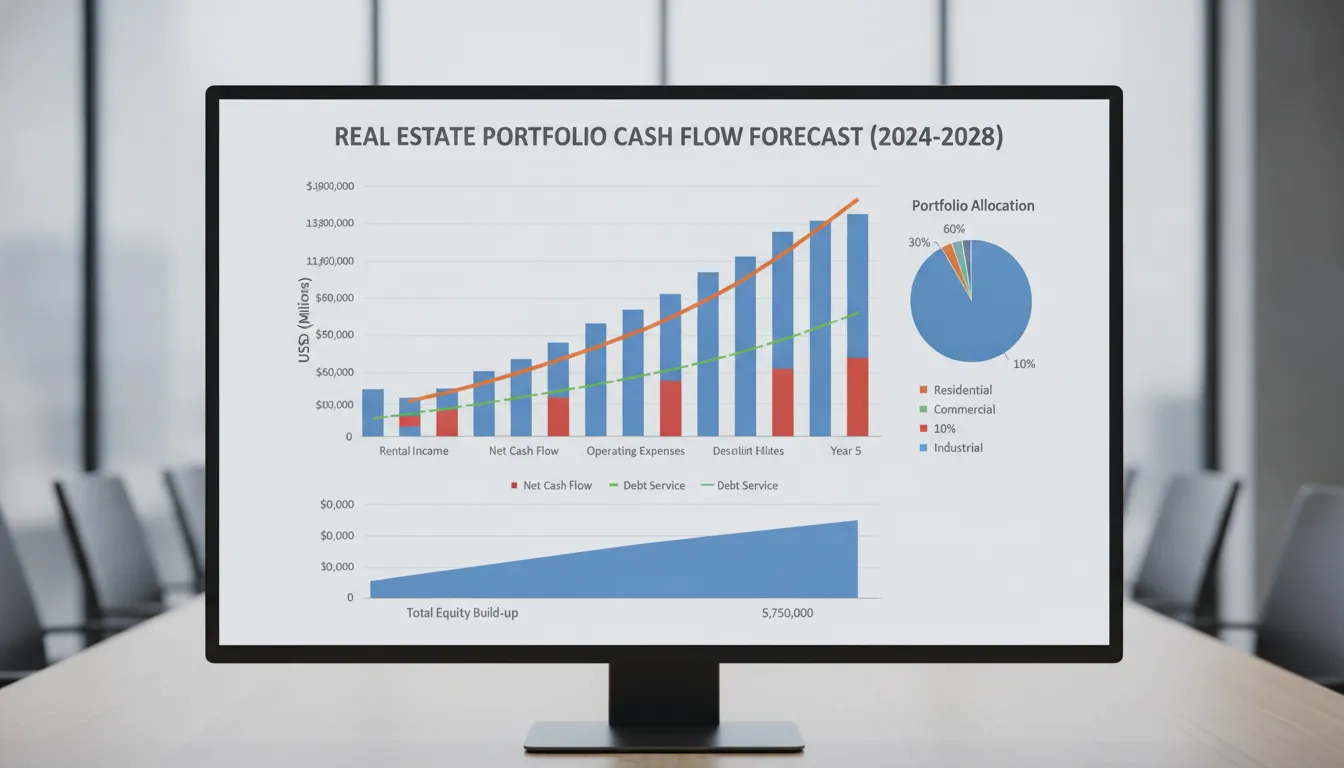
Real estate portfolio financial forecasting is the practice of projecting future income, expenses, and overall financial performance across your entire portfolio of investment properties. It combines cash flow projections, capital expenditure planning, debt service coverage analysis. And growth scenario modeling into a single framework that helps you make informed decisions about acquisitions, refinancing, and risk management. A well-built forecast transforms raw financial data into a strategic tool for sustainable growth.
Whether you are deciding when to buy your next property, planning for major capital improvements. Or preparing financial packages for lenders, a reliable forecast gives you the clarity to act with confidence. This guide walks through what portfolio financial forecasting involves, why it matters for multi-property investors, and how to build one that actually works for your business.
What Is Real Estate Portfolio Financial Forecasting?
Real estate portfolio financial forecasting is the process of estimating future income, costs, and overall financial health across your properties. While straightforward for a single property, the challenge scales significantly as you add units. A forecast helps you project cash flow, plan for major expenses before they hit, model growth scenarios, and evaluate how new acquisitions will affect your overall financial position.
Forecasting vs. Basic Bookkeeping
Many investors conflate bookkeeping with forecasting. Bookkeeping tracks historical transactions: every rent check, repair bill, and property tax payment is recorded for compliance and tax filing. Forecasting looks forward. It uses your historical data as a foundation to project portfolio performance over the next one to five years. Accounting for variables like lease renewals, expense inflation, and market rent trends.
A good forecast acts as a strategic map for your business. It accounts for events that have not happened yet but that carry known probabilities. Without it, you are reacting to surprises rather than planning around them. Accounting and CPA services for real estate portfolios provide the clean historical data needed to build reliable forward-looking models, ensuring your projections rest on verified facts rather than aspirational guesses.
The Foundation: Accurate Property Data
A reliable forecast starts with clean, organized property-level data. You need current rent rolls, lease expiration dates, property tax records, insurance premiums, and maintenance histories across every asset. You also need accurate vacancy and collection loss data to set realistic expectations.
Capital expenditure planning is one of the most commonly overlooked elements. Major items: roofs, HVAC systems, parking lots, and structural repairs follow predictable lifecycles but carry irregular costs. A proper forecast builds CapEx reserves into your monthly planning so you are never caught off guard by a six-figure repair bill. This level of discipline is what distinguishes serious portfolio managers from casual owners.
Key Financial Metrics for Portfolios
A comprehensive forecast tracks several essential metrics. Net Operating Income (NOI), calculated as total income minus operating expenses (before debt service), measures a property’s core earning power. The capitalization rate (cap rate), NOI divided by property value, allows comparison across different assets and markets. Cash-on-cash return, annual pre-tax cash flow divided by total cash invested, shows the actual yield on the money you put into each deal. And the Debt Service Coverage Ratio (DSCR), NOI divided by total debt payments, is the number lenders scrutinize most closely. Most commercial lenders require a DSCR of at least 1.25.
Why Do Multi-Property Investors Need a Financial Forecast?
Managing five to twenty properties brings a level of complexity that spreadsheets and mental math cannot handle. Real estate portfolio financial forecasting becomes the central tool for maintaining control and driving informed decisions across your growing portfolio.
Better Investment Decisions
A good forecast lets you evaluate potential acquisitions within your portfolio context. You can model how a new mortgage payment will affect overall cash flow. Which properties might need to be repositioned or sold, and whether your portfolio has the debt capacity to support another purchase. These are data-driven decisions, not gut calls, and they produce more consistent results over time.
Improved Cash Flow Management
Cash flow variability increases with portfolio size. When you hold ten or fifteen properties, the odds of multiple units needing simultaneous repairs or experiencing vacancy spikes go up significantly. A forecast identifies cash flow gaps before they become emergencies, allowing you to build reserves and maintain operating liquidity. This is especially important for covering debt service during lean months.
Risk Mitigation and Financing Confidence
Lenders evaluate multi-property borrowers on the strength of their financial management. A professional-grade forecast demonstrates that you understand your DSCR, have planned for vacancy losses, and maintain adequate CapEx reserves. Banks and commercial lenders consistently prefer borrowers who present consolidated portfolio-level projections rather than property-by-property napkin math. According to regulatory guidance from the Office of the Comptroller of the Currency, sound underwriting practices emphasize clear documentation of debt service capacity and capital reserves.
Key Components of a Portfolio Financial Forecast
Building a reliable forecasting model depends on five core components. Each one must be modeled with realistic, data-backed assumptions.
Income Projections
Start with your current rent roll, not aspirational market rents. Include base rent, parking fees, laundry income, storage fees, and any other revenue streams. Project rent growth based on market trends and lease renewal patterns. This gives you a realistic view of gross potential income across your portfolio.
Operating Expenses
Property taxes, insurance, repairs and maintenance, property management fees, utilities, and professional services must all be modeled individually. Each cost category follows different inflation patterns. For example, property insurance premiums have risen sharply in recent years, while property tax assessments follow local reassessment cycles. A line-item approach produces more accurate forecasts than applying a single expense percentage.
Debt Service
Loan payments representing principal and interest are typically your largest fixed cost. Model each loan separately with its rate, amortization schedule, and maturity date. This allows you to identify refinancing needs and test how rate changes will affect cash flow across the portfolio.
Capital Expenditure Reserves
CapEx reserves account for major building system replacements that follow predictable lifecycles. A roof may last 20 to 30 years, an HVAC unit around 15, and parking lot resurfacing 10 to 15. By estimating each property’s upcoming capital needs and setting aside reserves monthly, you avoid the financial disruption of large, unexpected outlays.
Vacancy and Collection Loss
Even well-managed portfolios experience vacancy and tenant nonpayment. Industry vacancy rates vary by market and property type, but ignoring this component inflates your projections. Fractional CFO services for real estate investors can help set realistic loss assumptions based on your portfolio’s actual history and local market conditions.
| Component | What It Includes | Why It Matters |
|---|---|---|
| Income Projections | Base rent, ancillary fees, other revenue | Shows total revenue potential across portfolio |
| Operating Expenses | Taxes, insurance, maintenance, management | Defines the ongoing cost of operations |
| Debt Service | Loan principal and interest | Largest fixed cost; drives cash flow analysis |
| CapEx Reserves | Roofs, HVAC, structural repairs | Prevents large, unexpected cash outflows |
| Vacancy Loss | Empty units and unpaid rent | Adjusts projections for real-world risk |
How to Build Your Forecast: A Step-by-Step Framework
Building a portfolio financial forecast follows a structured process that, once established, can be maintained and updated efficiently.
- Gather property-level data. Collect current rent rolls, lease schedules, historical expense reports, and loan statements. This data forms the factual foundation of your model. Small errors in base data compound into large forecast errors over time.
- Project rental income and vacancy. Analyze market rent trends for each property type and location. Apply realistic vacancy rates based on your portfolio’s history and local market data. The U.S. Census Bureau publishes rental vacancy data that can help benchmark your assumptions.
- Estimate operating expenses. Model each expense category separately using your historical data as a baseline. Add inflation buffers for categories that have been rising faster than general inflation, particularly property insurance and real estate taxes.
- Calculate debt service obligations. Model each loan with its specific terms including interest rate, amortization period, and maturity date. This allows you to calculate portfolio-wide DSCR and identify upcoming refinancing events.
- Set up CapEx reserves. Create a property-by-property capital reserve schedule based on the age and condition of each building’s major systems. Fund reserves monthly so the cash is available when replacements are needed.
- Model growth scenarios. Run multiple scenarios: optimistic, conservative, and base case. Test how your portfolio performs under different interest rate environments, vacancy rates, and acquisition schedules. This step is where portfolio forecasting delivers its highest value, helping you avoid over-leveraged positions before they become problems.

What Are the Most Common Portfolio Forecasting Mistakes?
Even experienced investors make predictable errors when building forecasts. Knowing these pitfalls helps you build models that reflect reality.
Overly Optimistic Rent Projections
The most common mistake is assuming maximum market rents with zero vacancy. Use actual rent rolls and market comparables rather than aspirational numbers. Budget for realistic vacancy rates typically 5 to 10 percent depending on your market and property type.
Neglecting Capital Expenditures
Small repairs appear in operating expenses, but major replacements are often excluded from forecasts. A single roof replacement or HVAC system overhaul can wipe out a year of operating profit. Building CapEx reserves into your monthly projections prevents this surprise.
Static, One-Time Forecasts
A forecast created once and never updated quickly becomes unreliable. Property insurance rates, tax assessments, and market rents change. Review your forecast quarterly and update assumptions at least annually. If you refinance a property or acquire a new one, update the model immediately.
Ignoring Interest Rate Risk
Rising interest rates affect both existing adjustable-rate debt and the cost of future financing. Stress-test your portfolio against rate increases of 100 to 300 basis points to understand your exposure.
Expert accounting and CPA services for real estate portfolios can identify these blind spots and ensure your forecast captures all the variables that matter.
When to Bring in a Professional: The CPA/CFO Advantage
Building a reliable forecast for a multi-property portfolio requires accounting expertise, market knowledge, and consistent maintenance through multiple market cycles. At five or more properties, the complexity of consolidating financial data, modeling multiple scenarios, and producing lender-ready packages often exceeds what investors can handle alongside their day-to-day operations.
Scenario Analysis and Stress Testing
Professional fractional CFO services for real estate investors bring sophisticated modeling capabilities that go beyond basic spreadsheets. A CPA-led team can stress-test your portfolio against interest rate hikes, vacancy spikes, and property tax increases. Running multiple scenarios simultaneously optimistic, conservative, and base case helps you understand your downside exposure before it materializes.
Lender-Ready Financial Packages
A professionally prepared forecast includes consolidated statements across all properties, clearly documented DSCR, and well-supported CapEx reserve schedules. Banks and commercial lenders view this level of preparation as a signal of borrower quality, which can improve your terms and speed up approvals.
The DMR Consulting Group Advantage
DMR Consulting Group brings over a decade of real estate-specific financial expertise to every engagement. Founded by Daniel Rutta, a CPA with Big Four experience and an active real estate investor managing substantial portfolio exposure. DMR understands both the numbers and the operational realities of property management. Their three-pillar model accounting and CPA services, tax planning and optimization, and CFO advisory gives investors a comprehensive financial back office that produces the kind of accurate, forward-looking data every good forecast requires.
Frequently Asked Questions About Portfolio Financial Forecasting
What is real estate portfolio financial forecasting?
Real estate portfolio financial forecasting is the process of estimating future income, expenses, and overall performance across multiple investment properties. It goes beyond basic bookkeeping by projecting cash flows, planning for capital expenditures, assessing debt service coverage, and modeling different growth scenarios. For investors with five or more properties, a consolidated forecast becomes essential for managing risk and planning acquisitions.
What are the key components of a real estate portfolio financial forecast?
The key components include rental income projections, operating expense estimates, debt service calculations, capital expenditure reserves, and vacancy and collection loss allowances. Each component must be modeled with realistic, data-backed assumptions to produce a reliable forecast that supports informed decision-making.
How often should I update my portfolio financial forecast?
A portfolio financial forecast should be reviewed quarterly and updated at least annually. Or whenever a significant change occurs such as acquiring or disposing of a property, refinancing debt, or when market conditions shift meaningfully. Regular updates ensure your model remains useful as a decision-making tool rather than a static document.
What is a good Debt Service Coverage Ratio for real estate investors?
Most lenders require a DSCR of at least 1.25 for commercial real estate, meaning net operating income exceeds debt payments by 25 percent. For residential investment properties, the minimum is typically 1.0, though experienced investors target 1.2 or higher to build a safety buffer. A strong DSCR signals to lenders that your portfolio can weather market fluctuations.
How can a CPA or CFO help improve my financial forecasting?
A specialized real estate CPA or CFO improves forecast accuracy by applying professional accounting standards, running scenario analyses, producing lender-ready consolidated statements, and ensuring compliance with tax regulations. Firms like DMR Consulting Group combine CPA credentials with active real estate investment experience, giving them practical insight into the numbers that matter most for portfolio growth.
Build a Forecast That Supports Your Growth
Accurate real estate portfolio financial forecasting is the foundation of smart portfolio management, confident acquisitions, and lender-ready financials. Whether you are managing five properties or scaling toward twenty, having a professional forecast in place helps you make better decisions with clearer data.
DMR Consulting Group specializes in helping real estate investors build and maintain financial forecasts that drive growth. Our team of CPAs and fractional CFOs understands real estate from the inside out because we are investors ourselves.
Contact DMR Consulting Group today to schedule a free consultation and learn how professional financial forecasting can support your portfolio’s next phase of growth.