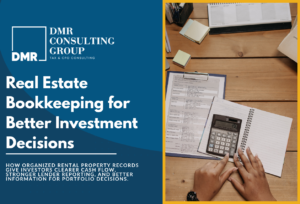

Managing several properties changes bookkeeping from a routine recordkeeping task into a portfolio control system. Each property may have separate income, debt, repairs, reserves, ownership structures, and reporting needs. When those details are blended together, it becomes harder to see which assets are producing cash, where expenses are rising, and what information your CPA needs for planning.
For most growing portfolios, what bookkeeping service is best for a multi-property real estate portfolio is a specialized real estate accounting or bookkeeping firm that can maintain property-level records. Close the books consistently, connect the right software, and turn accurate financials into better decisions. A DIY system or general virtual bookkeeper may work for a small, simple portfolio, but complexity usually increases the value of specialized oversight.
The right choice depends on your property count, entity structure, reporting expectations, and growth plans.
Get a bookkeeping and reporting review for your portfolio
Start by evaluating the level of real estate expertise and decision support a provider can bring, not just the monthly fee.
What Bookkeeping Service Is Best for a Multi-Property Real Estate Portfolio?
For investors weighing their options, the strongest choice for most growing portfolios is a specialized real estate accounting and bookkeeping firm. The right provider should do more than categorize transactions. It should turn property-level financial data into information you can use to evaluate cash flow, operating performance, financing decisions, and the next opportunity.
That distinction matters as the number of properties, entities, lenders, tenants, and management arrangements increases. A generic virtual bookkeeper may keep accounts current, and a do-it-yourself system may work for a small, simple portfolio. But neither option necessarily understands how real estate income, expenses, capital improvements, owner distributions, debt service, and property-level performance fit together. The best service combines reliable bookkeeping with the context needed to interpret those numbers.
Why real estate specialization changes the decision
Real estate bookkeeping has nuances that extend beyond routine small-business accounting. A specialized team can help establish reporting that reflects how investors actually manage assets, rather than producing one blended set of numbers that hides differences between properties. That makes it easier to see which assets are generating healthy operating results, where expenses need attention, and whether portfolio decisions are supported by dependable information.
Practical investment experience also matters. DMR Consulting Group’s team members are active real estate investors themselves, bringing an owner’s perspective to financial review. That experience can help connect bookkeeping activity to portfolio questions, instead of treating monthly close as an isolated compliance task. The firm’s approach positions financials as a decision-making tool, not merely a recordkeeping requirement. Explore DMR’s accounting and CPA services for real estate investors.
When a specialized firm is the better fit
A specialized firm is especially useful when you need consistent reporting across multiple properties. Coordination between bookkeeping and tax work, or a process that can become more advisory as the portfolio grows. You do not necessarily need an enterprise-level accounting organization to receive sophisticated support. Many investors need a high-touch partner with real estate expertise, but a service model scaled to an established individual portfolio, operating company, or investment group.
Before choosing a provider, ask about the areas that most affect whether the books support better decisions:
- How it separates property and entity reporting
- How it handles reconciliations and month-end review
- How it communicates exceptions and unusual activity
- How it coordinates with your CPA or tax team
If the answers focus only on transaction entry, the service may be too narrow. If the provider can explain how accurate books will improve visibility and support better portfolio decisions, it is closer to the right fit.
Scope of Work: What a Multi-Property Bookkeeping Service Should Cover
A capable bookkeeping engagement should create a consistent financial operating system for the portfolio, not simply record transactions. The scope should make performance easier to evaluate at the property level. Produce reliable month-end information, and give you repeatable processes as the number of entities and assets grows.
Property-level reporting that supports decisions
Every property should have a clear financial view, with income, operating expenses, capital expenditures, debt activity, and owner or partner transactions classified consistently. Reports should also roll up into a portfolio view without losing the detail needed to investigate an underperforming asset. This structure helps investors assess cash flow, compare properties, monitor budgets, and make better acquisition or disposition decisions. Financial data becomes a tool for clarity and control rather than a compliance file prepared after the fact.
Ask how the service handles separate legal entities, shared expenses, intercompany transfers, and property management activity. These details often determine whether a report is genuinely useful or merely polished.
A documented month-end close
Month-end close should be a defined process with ownership, deadlines, and review steps. A consistent month-end close should cover the core activities that keep every property accurate:
- Posting and classifying transactions in the correct period
- Reconciling bank and credit card accounts
- Reviewing rent and other income
- Recording recurring expenses
- Checking loan balances
- Investigating unusual variances
Consistent month-end processes are particularly important across a portfolio because incomplete reconciliations at one property can distort the consolidated picture.
Use a documented real estate month-end close checklist as a reference when evaluating a provider. The exact steps may vary by portfolio, but the service should be able to explain what is completed, what is reviewed, and when finalized reports are delivered.
Checklists and systems that scale
Monthly checklists should be tailored to the portfolio, then updated when you add properties, change management software, refinance an asset, or introduce a new entity. A scalable provider should also document its software and workflow decisions. The real estate accounting software selection checklist can help you ask whether integrations, user access, reporting depth, and transaction volume fit your operating model.
The goal is a repeatable close that reduces surprises while giving your CPA and advisory team dependable information for tax planning and higher-level portfolio strategy.
Property-Level Reporting and Software Integrations That Matter
For a multi-property investor, software is useful only when it turns scattered transactions into a reliable view of each asset and the portfolio as a whole. The system should support consistent coding, timely reconciliations, and reporting that helps you decide where to hold, refinance, improve, or exit. Property-level accounting also gives your CPA and advisory team a cleaner foundation for tax planning and performance analysis.
Build a separate financial picture for every property
A shared chart of accounts can preserve consistency across the portfolio, but each property needs its own tracking structure. That means recording rental income, repairs, utilities, insurance, debt service, capital improvements, and owner contributions in a way that can be filtered by property and entity. A property-level profit and loss statement should show operating performance without blending one asset’s results into another’s. Portfolio reporting can then roll those figures up for a broader view of cash generation, leverage, and concentration.
Cash flow reporting matters just as much as profit. An asset can show positive net income while debt payments, reserves, distributions, or upcoming capital work create a near-term cash constraint. Bank feeds can reduce manual entry, but they do not replace review. Transactions still need to be matched, categorized, assigned to the right property, and reconciled against statements. The accounting process, rather than the software alone, creates dependable information.

Choose integrations that reduce friction without weakening controls
Evaluate whether the accounting platform connects cleanly with your bank accounts, property management system, payment processors, loan records, and reporting workflow. Confirm how it handles multiple entities, transfers between properties, security deposits, recurring transactions, permissions, and historical data. DMR’s real estate accounting software selection checklist can help structure that evaluation before you commit to a platform.
Pricing varies significantly. One industry comparison lists DoorLoop at $69 per month for up to 20 properties, TenantCloud at $15, SimplifyEm at $35, and Sage 50 Pro at $578. Those figures are useful starting points, not a complete cost analysis. Consider implementation, user access, integrations, support, reporting limits, and the time required to maintain the system. A less expensive tool may become costly if it creates duplicate work or weak property-level controls.
Use reporting to support portfolio decisions
Good reporting should answer practical questions: Which properties are producing the strongest cash flow? Where are expenses drifting? How much liquidity is available for the next acquisition or renovation? More advanced portfolio analysis may use formal risk and optimization methods, including constraint-based approaches discussed in academic research on CVaR portfolio optimization. You do not need to build a research model to benefit from the principle: decisions improve when clean, comparable property data is available.
For investors who need help connecting systems and maintaining accurate property-level records, DMR’s property management accounting services can provide a more structured reporting foundation.
DIY, Virtual Bookkeeping, or a Real Estate Accounting Firm?
For a small portfolio with straightforward transactions, DIY bookkeeping can be workable. As properties, entities, loans, and reporting needs multiply, however, the deciding question is not simply who can enter transactions at the lowest price. It is whether the service produces reliable property-level information that supports decisions, tax coordination, and controlled growth.
| Evaluation area | DIY bookkeeping | Virtual bookkeeping service | Real estate accounting firm |
|---|---|---|---|
| Skill and property context | Depends on the owner’s accounting knowledge and available time. Real estate nuances may be missed. | May provide competent transaction processing, but expertise in entity structure, rentals, and investor reporting varies. | Built around real estate accounting, investor needs, and the distinctions among properties and entities. |
| Property reporting | Can be customized, but consistency often depends on one person maintaining the system. | Can improve regular reporting when the scope and chart of accounts are clearly defined. | Designed to deliver repeatable property and portfolio reporting that improves clarity and control. |
| Software integrations | Lowest service cost, but the owner selects, connects, and maintains the tools. | Often works within common cloud platforms and bank-feed workflows. | Can evaluate software against portfolio complexity and reporting requirements, not just convenience. |
| CPA coordination | Usually requires a separate CPA relationship and owner-managed handoff. | Coordination depends on the provider’s process and whether tax support is included. | Bookkeeping, accounting, and CPA services can operate from the same financial picture. |
| Cost and value | Lower direct cash cost, but substantial owner time and oversight. | Moderate recurring cost, with value tied to accuracy, responsiveness, and scope. | Higher professional cost, justified when better reporting and specialized guidance support scale. |

Software expenses are separate from service fees. For example, published starting prices cited in the research include DoorLoop at $69 per month for up to 20 properties, TenantCloud at $15, and SimplifyEm at $35. Those prices illustrate the range of tools available, not the total cost of a dependable accounting process. A senior fractional CFO engagement can be substantially more expensive, with one published estimate placing advanced engagements at $12,000 to $15,000 per month. The appropriate comparison is total value, including time recovered, reporting quality, and the cost of decisions made with incomplete information.
For most investors managing a growing, multi-property portfolio, a specialized real estate accounting firm is the strongest long-term choice. It allows the owner to offload complex accounting responsibilities while preserving access to financial information for decisions. DMR Consulting Group’s real estate accounting and CPA services are designed for investors who need sophisticated support without an enterprise-level firm. DIY or virtual bookkeeping may remain appropriate for a simpler portfolio, provided the process produces consistent reconciliations, property-level reporting, and a clean CPA handoff.
How Much Should Bookkeeping Cost for a Multi-Property Portfolio?
There is no single monthly price that fits every portfolio. The right budget depends on property count, entity structure, transaction volume, reporting requirements, and whether the service only records activity or helps you interpret it. Compare the value of timely, decision-ready financial information with the sticker price of the engagement.
Software-only bookkeeping: the lowest-cost starting point
Software can be appropriate for a simple portfolio when the owner has the time and accounting knowledge to maintain reconciliations, property-level records, and month-end procedures. Published examples show how widely software costs can vary: DoorLoop starts at $69 per month for up to 20 properties. TenantCloud at $15, SimplifyEm at $35, and Sage 50 Pro at $578, according to a real estate bookkeeping software comparison. Those prices cover tools, not the judgment required to configure accounts, classify transactions, review exceptions, or explain results.
Outsourced bookkeeping and real estate accounting firms
Virtual or outsourced bookkeeping usually costs more than software because you are paying for recurring transaction management, reconciliations, reporting, and process ownership. A real estate accounting firm may cost more again, particularly when the engagement includes entity-level books, investor reporting, CPA coordination, tax support, and portfolio-wide analysis. For owners seeking clarity, control, and scale, specialized support can be more useful than a low-cost service that produces reports without explaining what changed.
Ask prospective providers how they price the work: per property, per entity, by transaction volume, or through a fixed monthly scope. Confirm whether cleanup, onboarding, bill pay, rental income reconciliation, and year-end coordination are included. Also ask who reviews the books and what happens when the portfolio adds an entity or acquires a property. DMR’s real estate CFO services are designed for investors who need financial guidance beyond basic bookkeeping.
When the budget needs to include fractional CFO work
As a portfolio grows, the need often shifts from recording transactions to forecasting cash flow, evaluating acquisitions, managing debt, and setting reporting priorities. That is an escalation in scope, not simply a more expensive bookkeeping package. Senior fractional CFO engagements can reach $12,000 to $15,000 per month when advanced financial strategy is required, though actual pricing depends on expertise, scope, location, and duration. Review the signs in when to hire a real estate CFO before paying for that level of support. The best budget is the one matched to the decisions your portfolio must make next.
CPA Coordination and Multistate Compliance for Portfolio Owners
A bookkeeping service can keep transactions organized, but portfolio owners also need a clear connection between day-to-day accounting and CPA-led tax compliance. That coordination becomes especially important when properties, entities, or investors span multiple jurisdictions. The bookkeeper should maintain accurate property and entity records. While the specialized real estate CPA interprets those records in the context of filing obligations, ownership structures, and long-term planning.
Coordinate records across entities and states
Each property may have its own bank activity, debt, operating expenses, and ownership considerations. Without a coordinated process, information can arrive in inconsistent formats or be assigned to the wrong entity, creating avoidable delays during tax preparation. A real estate-focused accounting team can establish consistent coding, reporting, and review procedures before the CPA prepares filings.
For investors operating across Florida, New York, California, Texas, Tennessee, and Illinois, DMR Consulting Group describes multi-state filing coordination across these six key markets. The right workflow should identify which entities and activities create reporting requirements in each jurisdiction, then keep supporting records available for the tax team. This is not a substitute for individualized tax advice, but it gives the CPA a reliable foundation for that advice. Learn more about DMR’s real estate tax services.
Keep entity and FinCEN obligations visible
Entity administration can create compliance responsibilities beyond routine bookkeeping. A bookkeeping partner should flag ownership, entity, and transaction changes for CPA review rather than assuming that a standard monthly close addresses every requirement. FinCEN-related compliance is one example of a regulatory area that requires deliberate attention, current information, and clear ownership of the filing process. The precise obligation depends on the entity and circumstances, so investors should confirm requirements with qualified professionals.
Use a defined engagement model
Coordination works best when responsibilities are established at the start of the relationship. DMR’s three-phase engagement model, Discovery, Initialization, and Ongoing Partnership, provides a practical structure. Discovery clarifies the portfolio, entities, systems, and priorities. Initialization organizes records, reporting procedures, and workflows. Ongoing Partnership creates a recurring rhythm for bookkeeping, CPA coordination, and advisory review as the portfolio changes.
This integrated approach is different from treating bookkeeping as an isolated data-entry function. A specialized team can help connect accurate records with clearer decisions, while the CPA retains responsibility for professional tax guidance. DMR’s accounting and CPA services are designed for investors who need sophisticated support without an enterprise-level accounting firm.
Talk to DMR Consulting Group about your bookkeeping setup
Frequently Asked Questions
How do I choose the right bookkeeping service for my real estate portfolio?
Look for a provider that understands property-level accounting, reconciles accounts consistently, and produces reports you can use to evaluate cash flow, debt, operating performance, and future acquisitions. The right partner should also coordinate with your CPA and explain how the work will adapt as your portfolio grows.
What features should a real estate investor look for in a bookkeeping service?
Prioritize separate reporting for each property and entity, a consistent month-end close, bank and property-management system integrations, clear documentation, and an accounting method suited to your reporting needs. Ask how the service handles owner contributions, intercompany activity, capital improvements, security deposits, and short-term rental transactions.
What is the best accounting software for managing multiple real estate properties?
There is no universal best platform. The right choice depends on portfolio size, entity structure, rental model, reporting requirements, and existing systems. Compare property-level tracking, bank-feed reliability, user permissions, integrations, and export options before choosing software. A selection checklist can help prevent a low-cost platform from creating manual work later.
When should I move from basic bookkeeping to CFO-level support?
Consider additional financial oversight when routine reports no longer answer acquisition, financing, liquidity, or portfolio-allocation questions. Growing unit count, multiple entities, refinancing decisions, and a need for forward-looking analysis can indicate that bookkeeping should be connected to broader CFO and advisory work.
How can a bookkeeping service help with a portfolio owned across several states?
A specialized provider can organize property and entity records so your CPA has cleaner information for multistate filings and compliance. DMR Consulting coordinates multistate filing support across Florida, New York, California, Texas, Tennessee, and Illinois, according to its tax services overview.
Schedule a Consultation for Your Portfolio
A clear bookkeeping and reporting setup can make it easier to evaluate property performance and plan your next decisions. To review your current process and identify practical opportunities for stronger portfolio-level visibility, schedule a consultation with DMR Consulting Group.