

IRC Section 469 was enacted in 1986 to curb the use of real estate as a tax shelter. These rules still prevent many investors from using rental losses to reduce their overall tax liability.
Passive activity loss rules for real estate investors generally prevent you from using rental property losses to offset income from your job or business. Under IRS regulations, when rental expenses exceed rental income, the excess loss is disallowed for the current tax year. These suspended losses carry forward to future years until you generate sufficient passive income or sell the property. Understanding how material participation and real estate professional status can unlock these deductions sooner is essential for effective tax planning.
To plan your next move, you must first understand how the passive activity loss rules apply to your specific portfolio. This guide covers every exception and strategy available to real estate investors.
What Are Passive Activity Loss Rules for Real Estate Investors?
Passive activity loss rules under IRC Section 469 segment your income into three categories (active, portfolio, and passive) and restrict losses from one category offsetting income in another. For real estate investors, rental losses typically stay locked in the passive category unless specific exceptions apply.
These rules determine whether you can use rental losses to reduce your tax bill in any given year. Under Section 469, you generally cannot use a passive loss to offset active income like wages. This means a loss from one rental property cannot reduce the tax you owe on your salary.
The Origin of the Passive Loss Rules
Congress enacted the passive activity loss rules in 1986 as part of the Tax Reform Act. Before that, investors used real estate to generate paper losses that offset high salaries from unrelated professions. The reform forced taxpayers to match losses with the appropriate income category. Today these rules are a central focus of CPA services for real estate investors.
The Three Income Classifications
The IRS divides your income into three distinct buckets. Active income covers wages, salaries, and business income where you materially participate. Portfolio income includes investment returns from stocks, bonds, and interest. Passive income encompasses rental real estate and business activities where you do not materially participate. The passive activity loss rules prevent you from using a rental loss to offset your paycheck or capital gains.
How Suspended Losses Carry Forward
Disallowed losses do not disappear. The law lets you carry forward suspended passive losses indefinitely. These losses remain with the activity that generated them and can offset future passive income. When you eventually sell the property, all accumulated suspended losses become fully deductible against any income, including wages. Tracking these amounts accurately over multiple years is critical to avoid overpaying tax.
Why Rental Real Estate Is Automatically Passive
Rental real estate is classified as per se passive under IRC Section 469(c)(2), meaning the IRS treats it as passive regardless of how much time you spend managing it. This creates a structural barrier between rental losses and other income that only specific exceptions can overcome.
The tax code includes a rule known as “per se passive.” Even if you handle tenant placement. Coordinate repairs, and collect rents daily, the IRS may still classify the activity as passive. This wall between rental losses and your W-2 salary or business profits is why many investors find their losses suspended year after year. DMR Consulting Group’s tax efficiency for real estate investors services help navigate these restrictions.

Short-Term Rental Exception
Properties with an average customer use of seven days or less may escape the automatic passive classification. This exception commonly applies to Airbnb and vacation rental owners. When your property falls into this short-stay window, the per se passive rule does not apply, and losses may offset other income if you materially participate. See our short-term rental bookkeeping checklist for tracking requirements.
Why Your Participation Level Still Matters
Even with the automatic passive rule. Your involvement level determines which exceptions you qualify for. “Active participation” (a lower standard than material participation) unlocks the $25,000 special allowance discussed below. The ultimate goal for high-income investors is to achieve non-passive treatment through real estate professional status.
The $25,000 Rental Real Estate Exception
The $25,000 special allowance lets eligible investors deduct up to $25,000 in rental losses against non-passive income. To qualify, you must actively participate in the rental activity and have a modified adjusted gross income below $100,000 (phasing out completely at $150,000).
This exception serves as the primary relief valve for investors who have not yet qualified as real estate professionals. It provides immediate tax benefits without the 750-hour annual requirement.
Active Participation Requirements
You qualify for active participation by owning at least 10% of the property and making significant management decisions (selecting tenants, approving leases, and authorizing major repairs). Unlike material participation, you do not need to handle day-to-day operations. As long as you retain final decision-making authority, you likely meet this standard. The IRS Publication 925 provides detailed guidance on the distinction between active and material participation.
Maintain records of your management decisions: signed lease approvals, vendor contracts, and email correspondence with your property management team. These documents establish active participation if the IRS questions your eligibility.
Income Phaseout Rules
The $25,000 allowance phases out for investors with modified adjusted gross income above $100,000. For every $2 of income above this threshold, you lose $1 of the allowance. At $150,000, the allowance disappears entirely. DMR Consulting Group works with investors in states including Florida, New York, California, Texas, Tennessee, and Illinois to structure portfolios that maximize this benefit.
How to Qualify as a Real Estate Professional
Real estate professional status (REPS) is the most powerful tool for bypassing passive activity loss limitations. When you qualify, your rental activities are no longer automatically passive, allowing losses to offset any income including W-2 wages and business profits.
For high-income investors, REPS is often the difference between carrying suspended losses indefinitely and using them immediately. Qualification requires meeting two strict tests each tax year.
The Two-Part Qualification Test
- 750-Hour Minimum: You must spend more than 750 hours per year in real property trades or businesses where you materially participate. Qualifying trades include property development, construction, rental management, brokerage, and real estate lending.
- 50% Requirement: More than half of your total working time for the year must be in these qualifying real estate activities. This test is difficult if you hold a full-time job outside real estate.
Your spouse’s time can help meet the material participation test on a joint return. Even if only one spouse qualifies as a real estate professional, both spouses’ hours on rental activities count toward material participation. This opens a strategic path for households where one spouse works in real estate part-time.
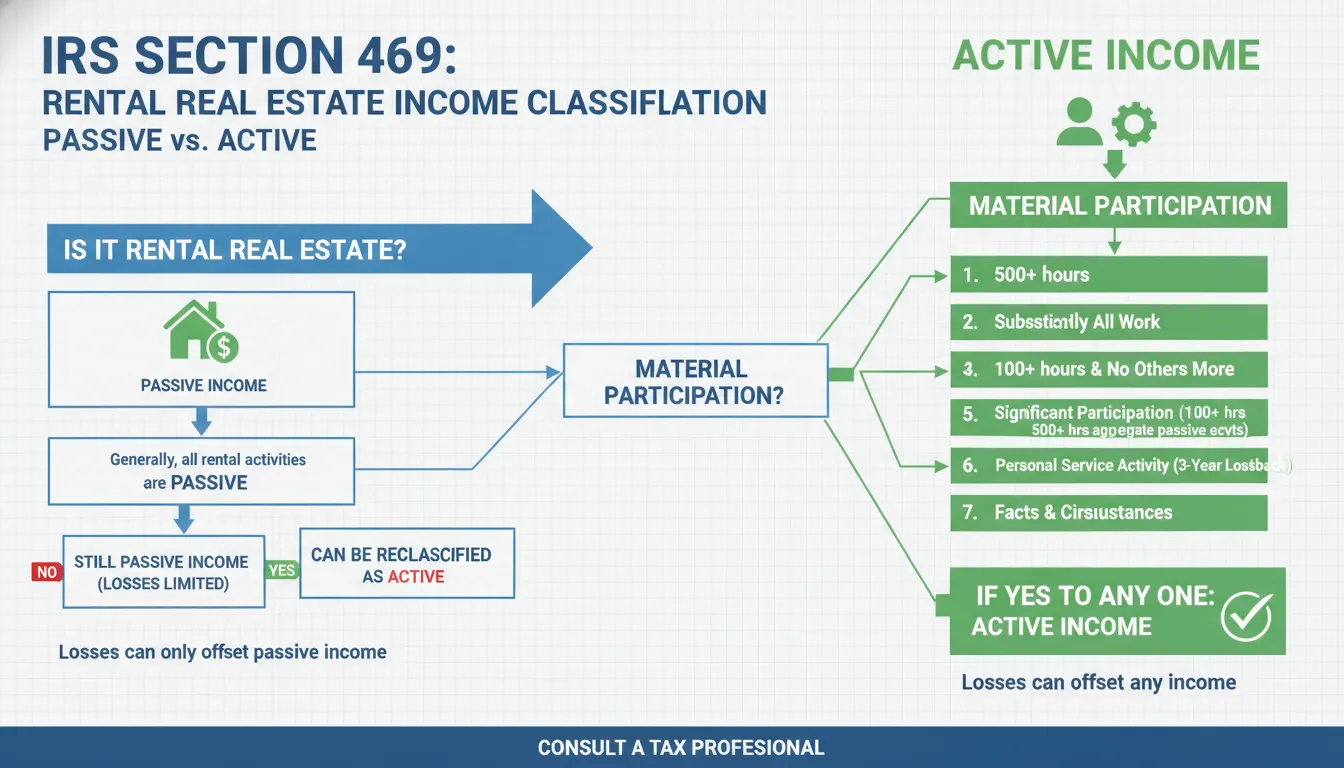
| Test Number | Test Name | The Rule |
|---|---|---|
| Test 1 | 500-Hour Rule | You work more than 500 hours in the activity during the tax year. |
| Test 2 | Sole Participant | Your work constitutes substantially all of the work in the activity. |
| Test 3 | 100-Hour Rule | You work more than 100 hours and no one else works more than you. |
| Test 4 | Significant Participation | You work over 100 hours across multiple activities totaling over 500 hours. |
| Test 5 | Prior Participation | You materially participated in any five of the prior ten tax years. |
| Test 6 | Service Activity | You materially participated in any three prior years for a personal service business. |
| Test 7 | Facts and Circumstances | You work on a regular, continuous, and substantial basis based on all facts. |
Real-Life Application
A real estate agent who spends 1,200 hours annually on client transactions and also owns a rental property generating a $15,000 loss would normally lose the deduction at a $150,000+ commission income level. However, because the agent spends more than 750 hours in real estate and that time exceeds 50% of total work hours, they qualify as a professional. By demonstrating material participation (at least 500 hours managing their own rental), they can deduct that loss against commissions.
Proving Your Hours to the IRS
The IRS permits any reasonable means of substantiating your time. Calendars, appointment books, or contemporaneous time logs all suffice. You do not need daily time reports, but you must produce credible evidence upon examination. A systematic tracking habit protects your deduction if the IRS ever challenges your professional status.
What Happens to Disallowed Passive Losses
Disallowed passive losses do not vanish. They become suspended losses that carry forward indefinitely to offset future passive income or become fully deductible when you sell the property in a fully taxable transaction.
Understanding the disposition rules and grouping strategies helps you turn today’s paper losses into tomorrow’s tax savings.
Carrying Forward Suspended Losses
You can carry forward disallowed passive losses to the next tax year with no limit on duration. Each year, you determine whether your passive activities generated net income that can absorb the suspended losses. Proper record keeping across multiple years and properties is essential. A real estate tax expert can help ensure no loss goes unused.
Full Disposition Triggers Full Deductibility
The cleanest way to unlock suspended losses is to sell the property. When you dispose of your entire interest in a passive activity to an unrelated party, all prior suspended losses become fully deductible against any income category, including wages. This makes the sale of an underperforming or fully depreciated property a strategic tax event.
Grouping Properties as Economic Units
The IRS allows you to group multiple activities into a single economic unit. If one property generates a loss while another produces income, grouping them lets the loss offset the gain in the same year. This is particularly valuable for multi-state investors who need to coordinate tax planning across state lines. Once elected, a grouping method must remain consistent unless there is a material change.
Multi-State Portfolio Considerations
Investing across state lines adds layers of complexity to passive loss planning. While most states conform to federal passive activity loss rules, states like California and New York may impose independent limitations or decouple from federal treatment in specific ways.
Real estate investors maintaining portfolios in multiple markets must reconcile each state’s approach to passive losses with their federal strategy. DMR Consulting Group serves investors with holdings in Florida, New York, California, Texas, Tennessee, and Illinois, helping them navigate both federal and state requirements.
State Conformity and Deviations
Most states follow federal passive activity loss rules closely, meaning losses deductible federally are also deductible at the state level. However, California and New York sometimes diverge. California does not automatically conform to federal REPS rules, and New York may apply different material participation standards. You must verify each state’s treatment to avoid overpaying or underpaying state tax.
Cross-State Grouping Strategies
Federal grouping elections allow you to treat multiple properties as a single economic unit, simplifying participation tracking. However, states may not accept federal grouping across state lines. A property in Texas and another in Illinois cannot always be grouped for state purposes. This discrepancy requires dual tracking (one grouping method for federal returns and potentially different groupings for each state filing). Proper coordination between your federal and state returns is essential for multi-state tax compliance.
Frequently Asked Questions
Can rental real estate losses offset active income?
Mostly, rental real estate losses are passive and cannot offset active income like W-2 wages. However, real estate professionals can treat rental losses as non-passive. Active participants meeting income limits may also deduct up to $25,000 in losses annually through the special allowance.
Can I release passive carryover losses when I sell a property?
Yes. All suspended passive losses become fully deductible when you sell your entire interest in the property to an unrelated party. Per the IRS, these carryforward losses first offset any gain from the sale, and remaining losses can offset non-passive income including your salary.
Are all rental real estate activities considered passive?
Most rental real estate is passive by default, but short-term rentals with average guest stays of seven days or fewer may escape this classification under Section 469. These properties may be treated as active businesses if you materially participate, allowing losses to offset other income without real estate professional status.
What is considered active participation for real estate investors?
Active participation requires at least 10% ownership and involvement in significant management decisions like approving tenants, setting rental terms, and authorizing repairs. It is a lower threshold than material participation and unlocks the $25,000 special allowance for qualifying investors.
Turn Your Passive Losses Into Active Tax Savings
Tax laws governing passive activities are complex and evolve frequently. Waiting until year-end to evaluate your material participation or REPS qualification means leaving deductions on the table. DMR Consulting Group’s experienced team helps real estate investors manage these rules across federal and state filings, ensuring every allowable deduction is captured.
Ready to optimize your real estate tax strategy? Schedule a consultation with DMR Consulting Group’s real estate tax specialists today.