
A growing rental portfolio can hide weak properties behind strong total cash flow. Once several LLCs share one vague ledger, clean books stop producing clear investment decisions.
Ready to build a clean accounting foundation for your rental portfolio? Schedule a consultation with DMR Consulting Group to design an account structure that scales with your properties.
A rental property chart of accounts is a structured list that classifies every portfolio transaction as an asset, liability, equity item, income, or expense. For investors managing several rentals or LLCs, the strongest setup keeps those core categories consistent while using property and entity tracking to separate results. It should distinguish rent, late fees, security deposits, mortgages, owner contributions, repairs, taxes, insurance, utilities, management fees, and transfers between entities. That structure reveals each property’s performance, supports accurate records, and gives investors reliable numbers for comparing cash flow and planning their next move. It also prepares cleaner tax inputs because the AICPA says rental income and expenses are generally reported on Schedule E.
Building the right system means deciding what stays standard across the portfolio and what must remain separate for each property and LLC. Rental property chart of accounts for multi-property investors addresses that balance first, including how to structure accounts without creating a cluttered ledger. Here is how:
Rental property chart of accounts for multi-property investors
A rental property chart of accounts is the organized list of accounts used to record each portfolio transaction. It groups activity into assets, liabilities, equity, income, and expenses. The HUD rental recordkeeping guidance also explains which rent receipts belong in income.
For a multi-property investor, that list must do more than sort transactions. It should use one clear structure while showing results by property and legal entity. This approach turns routine bookkeeping into a reliable view of the whole portfolio.
A shared structure with property-level detail
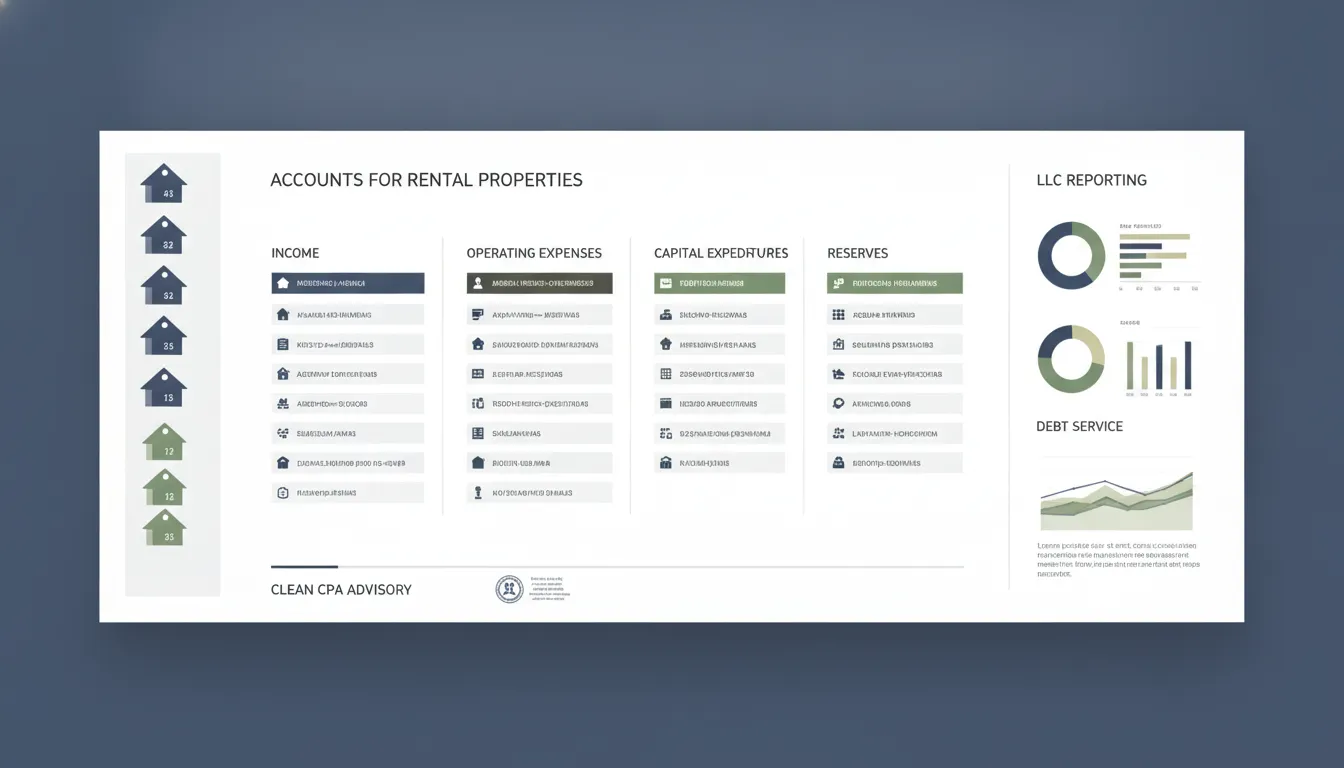
A basic template may create a different income or repair account for every building. That setup soon becomes hard to read. Instead, use shared account names and attach a property, class, or location tag to each transaction.
For example, every property can use the same rent income and repair expense accounts. Property tags then show which building earned the rent or required the work. This structure supports consistent accounting and CPA services without losing asset-level detail.
- Use standard account names across the portfolio.
- Track each property with a separate tag or class.
- Keep deposits, loans, and fixed assets tied to the correct property.
- Add new accounts only when they improve reporting or tax records.
Clear boundaries between properties and LLCs
Properties held in separate LLCs need clean books for each entity. Bank accounts, loans, owner contributions, and distributions should stay with the entity that owns them. A shared chart provides consistency, but it must not blur legal or financial boundaries.
Transfers between entities also need matched entries and clear notes. Record a transfer as an intercompany receivable, payable, contribution, or distribution based on its purpose. This discipline supports accounting for multiple rental entities and reduces unexplained balances during review.
Reports built for decisions and tax prep
A strong rental property chart of accounts supports several reporting views from the same records. Investors should be able to review one property, one LLC, or the full portfolio. Each view answers a different question about cash flow, debt, costs, and performance.
- Property profit and loss shows operating results by asset.
- Entity balance sheets show cash, debt, equity, and amounts due between LLCs.
- Portfolio reports make it easier to compare properties using the same categories.
- Tax-ready expense groups help the CPA review rental activity with less cleanup.
This design also makes weak spots easier to find. A rising repair account may point to an aging asset, while uneven rent collections may signal an operating issue. Consistent records help investors act on those patterns instead of waiting for year-end tax work.
How should account categories be structured?
A rental property chart of accounts should start with five account types: assets, liabilities, equity, income, and expenses. This framework gives every transaction a clear home. The IRS rental record guidance supports this five-part framework for sorting transactions. Clear categories make the process easier.
Core account framework
Each main account type answers a different question about the portfolio. Assets show what the business owns, while liabilities show what it owes. Equity tracks owner value and contributions. Income and expense accounts explain how rental activity changed results during the period.
| Account type. | What it tracks. | Rental property examples. |
|---|---|---|
| Assets. | Resources the business owns or controls. | Cash, buildings, land, tenant receivables, and security deposits held. |
| Liabilities. | Amounts the business owes. | Mortgages, unpaid bills, credit balances, and deposits owed to tenants. |
| Equity. | Owner investment and retained value. | Owner contributions, owner draws, and retained earnings. |
| Income. | Money earned from rental operations. | Rent, late fees, application fees, laundry income, and amenity fees. |
| Expenses. | Costs tied to rental operations. | Repairs, property taxes, insurance, utilities, and management fees. |
The five types should stay consistent across the portfolio, even when properties sit in separate LLCs. Consistency helps investors compare results without translating different labels first. Owners with several entities can review accounting for multiple rental entities before choosing a shared account structure.
Useful income and expense detail
Income categories should separate rent from other charges that may reveal how a property operates. Useful accounts include base rent, late fees, application fees, laundry income, and amenity fees. This detail shows where revenue comes from without creating an account for every tenant or payment.
Expense categories need the same balance. Separate repairs, property taxes, insurance, utilities, and management fees because each cost supports a different decision. A repair account may need subaccounts for plumbing or electrical work when that detail guides budgets. Avoid extra layers that no one will review.
A structure that scales
Use the chart of accounts for the nature of each transaction, not the property name. Track the property, unit, and entity through classes, locations, or other reporting fields in the accounting system. This approach keeps the account list readable as the portfolio grows. It also supports cleaner property-level reports.
Before adding a category, ask whether it will change a tax, cash flow, or operating decision. If not, a broader account may be enough. Investors who need a tailored chart of accounts or comprehensive property management accounting support can schedule a consultation with the DMR team.
How do you track multiple properties without messy books?
Use one rental property chart of accounts across the portfolio, then add a separate tracking value for each property. This structure keeps account names stable while showing which building earned income or caused a cost. Without that second layer, one profitable rental can hide another property’s weak results.
One chart, separate property views
Most accounting systems offer classes, locations, tags, or property IDs for this purpose. Choose one method as the main property field and apply it to every transaction. Use clear names such as FL-Miami-Oak-101 or NY-Bronx-Grand-220, rather than vague labels such as Property 1.
Keep the base accounts consistent across all rentals. Repairs, mortgage interest, utilities, insurance, and rental income should use the same account names for every property. The property field then separates each building’s activity without creating a long list of duplicate accounts.
Subaccounts can add useful detail when management needs it. For example, Repairs may contain Plumbing, HVAC, and Turnover subaccounts. Do not create a unique repair account for every address. Investors who hold rentals in separate LLCs should also review the added needs of portfolio-level planning.
Consistent coding for every transaction
Set a rule that each income or expense entry needs an account, property ID, and entity before it is approved. A plumbing invoice would post to Repairs: Plumbing and carry the code for the rental that received the work. A utility bill and insurance premium would follow the same pattern.
Mortgage payments need more care because principal and interest serve different purposes. Record interest in the mortgage interest expense account and apply the correct property code. Record principal against the related loan balance, not as an expense. Keep each loan in its own liability subaccount so balances stay tied to the right property.
Use separate equity subaccounts for owner contributions and distributions. Tag each entry to the proper entity and property when the system allows it. This prevents a cash deposit from looking like rental income and makes funding activity easier to trace.
Clear treatment of repairs and improvements
Do not place repairs and capital improvements in one expense bucket. Routine work may fit a repair or maintenance account, while an improvement may belong in a fixed asset account. The IRS guidance on rental income and expenses explains that rental expenses generally relate to producing income or managing, conserving, and maintaining the property.
Apply the same coding rule to every improvement: select the asset account, property ID, and entity. Add a short note that states what changed and save the invoice. These records give the tax preparer a cleaner basis for reviewing the treatment.
Run a profit and loss report by property each month, then compare it with the full portfolio report. Review uncoded entries, unusual changes, and costs assigned to a general bucket. This habit turns rental property accounting essentials into useful property-level decisions rather than year-end cleanup.
Build the chart around tax preparation and Schedule E
Schedule E mapping
A tax-ready rental property chart of accounts should make each property’s income and costs easy to trace. The IRS says rental real estate income and expenses are generally reported on Schedule E, Supplemental Income and Loss. Build account names that help your tax professional move from the ledger to the return without broad, unclear categories.
Keep the same core expense accounts for every property and entity. Common groups include advertising, insurance, management fees, mortgage interest, repairs, property taxes, and utilities. Add subaccounts only when they help explain a cost or guide a decision. Too many narrow accounts can make coding harder and produce uneven reports.
- Separate rent from late fees, application fees, and other property income.
- Track each property’s activity with classes, locations, or another consistent field.
- Keep owner contributions, distributions, loans, and transfers out of rental income and expense accounts.
- Use a review account for transactions that need more detail before final coding.
Records that support each entry
Clean categories are only useful when each entry has support. Link invoices, receipts, lease records, bank statements, and payment details to the related transaction when possible. A clear memo should state the property, vendor, purpose, and work performed. Consistent documentation helps your tax professional review whether a cost fits the applicable tax rules.
Use separate accounts to distinguish routine repairs from larger property work that may need different tax treatment. Do not decide based on the payment amount alone. Record enough detail for a qualified tax professional to assess the item. This approach also strengthens proper rental property bookkeeping throughout the year.
For investors with several rentals or LLCs, retain support within the correct entity and property record. Document transfers between related accounts, including the business reason and both sides of the entry. This prevents a transfer from being mistaken for income or an expense. It also makes intercompany balances easier to reconcile.
A tax-ready review process
Review the ledger on a set schedule instead of waiting for filing season. Reconcile bank and credit card accounts, clear uncategorized items, and confirm that each property has complete income and expense records. Compare account balances with loan statements, tax bills, insurance records, and property management reports.
Before sharing the books, scan for personal costs, duplicate entries, missing documents, and large changes from prior periods. Ask a tax professional to review uncertain items and entity-specific issues. DMR’s tax services for real estate investors can help connect the books with tax planning and preparation. The final tax treatment depends on each investor’s facts and applicable rules.
A scalable setup process for one property to a portfolio
A scalable rental property chart of accounts starts with one shared structure, not a separate design for every new LLC. The structure should preserve property-level detail while letting the owner review the full portfolio.
Build the setup with a CPA before growth makes past records harder to fix. This approach also supports rental property accounting essentials without adding needless accounts each time a property closes.
Plan the reporting structure
Start with the decisions each report must support. An investor may need property profit, entity cash, debt balances, owner contributions, and portfolio trends. The CPA should define which details belong in accounts and which belong in tracking fields.
- Review the existing books. Find duplicate accounts, mixed personal costs, uncategorized items, and inconsistent property labels. Note where one LLC paid costs for another.
- Define reporting needs. List the monthly reports needed by owners, lenders, property managers, and tax advisers. Set a clear level of detail for each audience.
- Map the core accounts. Use one base list for assets, liabilities, equity, income, and expenses. Keep accounts broad enough to support clean portfolio reports.
- Choose tracking dimensions. Decide whether the system will track each property, unit, LLC, project, and owner through classes, locations, tags, or separate files.
- Standardize names. Create one naming rule for properties, entities, bank accounts, loans, and tracking fields. Document short forms so every user applies them the same way.
- Test the reports. Enter sample rent, repairs, debt payments, owner funding, and shared costs. Confirm that property, entity, and portfolio reports show the right results.
- Review with a CPA. Have the CPA check account mapping, entity separation, tax reporting needs, and the month-end process before the structure goes live.
Separate accounts from tracking fields
Accounts describe the type of transaction, while tracking fields show where it belongs. For example, repairs can stay as one expense account while a property tag assigns each bill. This design avoids a long list of nearly identical repair accounts.
Entity boundaries still matter. The process for accounting for multiple rental entities should record transfers, shared bills, and owner funding with clear support. It should not hide those items inside broad expense categories.
Test before adding the next property
Run a monthly close with sample data before using the design across the portfolio. Compare each property’s profit and loss statement with the entity and portfolio views. Then trace several balances back to bank, loan, and lease records.
Tax reporting should also shape the test. The IRS notes that rental income and expenses are generally reported on Schedule E. A CPA can confirm how the books should support that filing and any entity-specific returns.
Record the approved account list, naming rules, tracking fields, and close steps in one operating guide. Require a short CPA review when new facts change the reporting needs. These facts may include an LLC, loan, property type, or ownership structure.
Common chart of accounts mistakes that hide portfolio performance
A rental property chart of accounts should make each asset, entity, and obligation easy to review. Yet small setup choices can blur profitable properties with weak ones. They can also slow tax prep and weaken the financial package presented to a lender.
Too much detail or too little control
Too many accounts create noise and invite staff to code the same cost in different places. Too few accounts hide useful trends, such as rising maintenance costs or falling fee income. The right level of detail supports decisions without making monthly bookkeeping hard to maintain.
- Too many accounts: Separate accounts for every vendor or minor purchase make reports long but not more useful.
- Too few accounts: A broad “property expense” account hides repairs, utilities, insurance, taxes, and management fees.
- Inconsistent names: Labels such as “Unit 1,” “Oak Street,” and “Oak LLC” can refer to the same asset across reports.
Use one naming rule and a short list of decision-useful categories. Keep the main account list stable as the portfolio grows. Investors can then compare periods without rebuilding reports or explaining old naming choices.
Classification and entity errors
Mixing capital improvements with routine repairs can distort operating results and create extra work during tax prep. The IRS explains that rental expenses generally relate to income production, management, conservation, or maintenance. Clear coding gives the tax professional a better starting point for reviewing each cost.
- CapEx mixed with repairs: A roof replacement should not disappear inside routine maintenance spending.
- Entities combined: One set of books for several LLCs can hide transfers, cash needs, and entity-level obligations.
- Owner costs in operations: Personal spending placed in property accounts overstates costs and understates operating profit.
Separate books or clear entity dimensions help preserve each entity’s financial story. They also make intercompany transfers easier to trace. A consistent approach to accounting for multiple rental entities can reduce confusion when investors, tax professionals, and lenders review the same records.
Missing property data and balance checks
Entity-level totals alone do not show which property produces cash or consumes it. Without property tags, income and costs cannot be grouped into reliable asset-level results. That gap makes hold, sell, refinance, and budget choices harder to support with data.
Unreconciled liabilities create a different risk. Loan, credit card, tax, and security deposit balances may no longer match outside records. This can make net worth, debt, and available cash look wrong in a financing package.
Assign every transaction to the right entity and property, then reconcile liability accounts on a set schedule. Review uncategorized items, owner transactions, and intercompany balances before closing the period. These controls turn rental property accounting essentials into reports that support real portfolio decisions.
Turn account structure into better investor decisions
A rental property chart of accounts should do more than sort transactions. Its structure should show where a portfolio earns cash, where costs rise, and where capital may be at risk. When every property and entity follows the same account map, investors can compare results without rebuilding reports each month.
Property-level performance and cash flow
Property-level profit and loss statements turn account detail into useful operating measures. Investors can track rental income, operating costs, net operating income, and debt payments for each asset. Separate accounts for recurring repairs and major improvements also make trends easier to see.
Cash flow reporting adds another layer. A profitable property can still face a cash squeeze when loan payments, large repairs, or owner draws fall due. Clear accounts help investors see those demands before they affect other assets. The IRS also notes that rental income includes payments received for the use or occupation of property. Consistent income categories support that rental income recordkeeping.
Reporting, reserves, and financing
A lender may ask for current financial statements, property results, or proof of available cash. Standard account names and clean property tags make those reports faster to prepare. They also reduce the risk of mixing one entity’s activity with another’s results.
Reserve planning becomes more useful when the accounts separate routine spending from larger capital needs. Investors can compare repair history, insurance costs, taxes, and planned projects by property. That view helps set reserve targets based on each asset’s needs instead of one broad portfolio estimate.
- Track actual results against the operating budget.
- Review debt payments and cash needs by entity.
- Flag unusual cost changes before they become recurring problems.
- Prepare consistent reports for lenders and partners.
Acquisition and portfolio analysis
Consistent accounts also improve acquisition reviews. Investors can compare a target property’s projected income and costs with actual results from similar assets. After closing, the same account map makes it easier to test whether the property is meeting its plan.
At the portfolio level, investors can compare margins, cash flow, reserve needs, and debt demands across several properties. This supports decisions about which assets to hold, improve, refinance, or review for a sale. It also helps investors assess whether a new purchase adds healthy cash flow or more strain.
Useful reports depend on accurate inputs and a structure built for real estate. DMR’s guide to real estate investment accounting explains the broader reporting foundation. For investors who need forecasts, KPI design, and regular decision support, DMR’s CFO services connect account data to portfolio planning.
Frequently Asked Questions
How do you set up a chart of accounts for multiple rental properties?
Start with one consistent account structure for assets, liabilities, equity, income, and expenses. Then use property, class, or location tags to separate each rental’s activity. Keep separate books when different LLCs require distinct financial statements. Add accounts only when they support useful reporting, and review the structure before adding another property.
What income categories should be included in a rental property COA?
Include separate income accounts for base rent, late fees, application fees, parking, laundry, amenities, and tenant reimbursements. Record advance rent when received. Security deposits applied as final rent also become rental income, according to the IRS. Use property-level tracking so reports show which rentals and income sources drive portfolio performance.
What expenses should be categorized in a rental property chart of accounts?
Common expense accounts include repairs, maintenance, property taxes, insurance, utilities, management fees, professional fees, and mortgage interest. Separate capital improvements from routine repairs because their accounting treatment may differ. The IRS states that rental expenses must relate to producing income or managing, conserving, or maintaining income-producing property.
Why is a chart of accounts essential for real estate bookkeeping?
A rental property chart of accounts creates consistent categories for every transaction, which improves financial reporting and tax preparation. For a multi-property portfolio, it also supports property-level profit comparisons, cash flow reviews, and consolidated reporting. Consistent categories make unusual costs easier to spot and help investors evaluate each rental without mixing transactions across properties or LLCs.
Ready to Build a Scalable Rental Accounting System?
Waiting to organize your accounts allows unclear property performance, inconsistent records, and avoidable cleanup work to grow with every rental or LLC. As your portfolio expands, those problems can make monthly reviews slower and year-end preparation harder for you and your accounting team. Starting now creates a cleaner foundation for property-level reporting, more useful portfolio comparisons, and a smoother process as you add entities.
Ready to bring structure to your growing portfolio? Schedule a consultation to discuss an accounting system aligned with your rentals, LLCs, and reporting needs. Contact DMR Consulting Group now to identify practical next steps across each property and entity before another month of inconsistent records adds to the cleanup.