
Buying rental property with a retirement account creates strict tax rules for every dollar spent. You must keep clear paths between personal cash and IRA funds to avoid heavy IRS penalties. Solid records protect your assets from high costs. Without proper accounting, even a single misplaced expense can trigger IRS scrutiny and threaten the tax-advantaged status of your entire retirement portfolio.
What Is Self-Directed IRA Real Estate Bookkeeping?
Self directed ira real estate bookkeeping is the system of tracking all rental income, expenses, and transactions within a Self-Directed IRA or Solo 401(k) while maintaining strict separation from personal funds. It ensures compliance with IRS prohibited transaction rules and preserves the tax-advantaged status of your retirement account.
A Self-Directed IRA (SDIRA) gives you the freedom to hold real estate assets that standard plans do not allow. While a regular IRA often limits you to stocks and bonds, an SDIRA lets you buy rental homes, land, or commercial buildings. To stay compliant, you must use accounting services for real estate investors to track every dollar that flows in and out of the plan.
The role of the custodian
Even though you choose your own assets, you cannot hold these funds in a personal bank account. Internal Revenue Service rules require an IRA to have a custodian. This is a bank or firm that holds the assets and makes sure your plan follows tax law. The custodian handles the paperwork and carries out the buys or sells you choose. They do not give advice, so you are in charge of due diligence on each deal.
Avoiding the personal benefit rule
The core rule of an SDIRA is that the property must be for investment only. You or your family cannot live in the home or use it as a vacation spot. Rules from The Entrust Group show that you must ensure you get no personal gain from the assets in the plan. This means you cannot pay yourself a fee to manage the property or use it as a backstop for a personal loan.
Why Is SDIRA Real Estate Bookkeeping Different from Standard Rental Accounting?
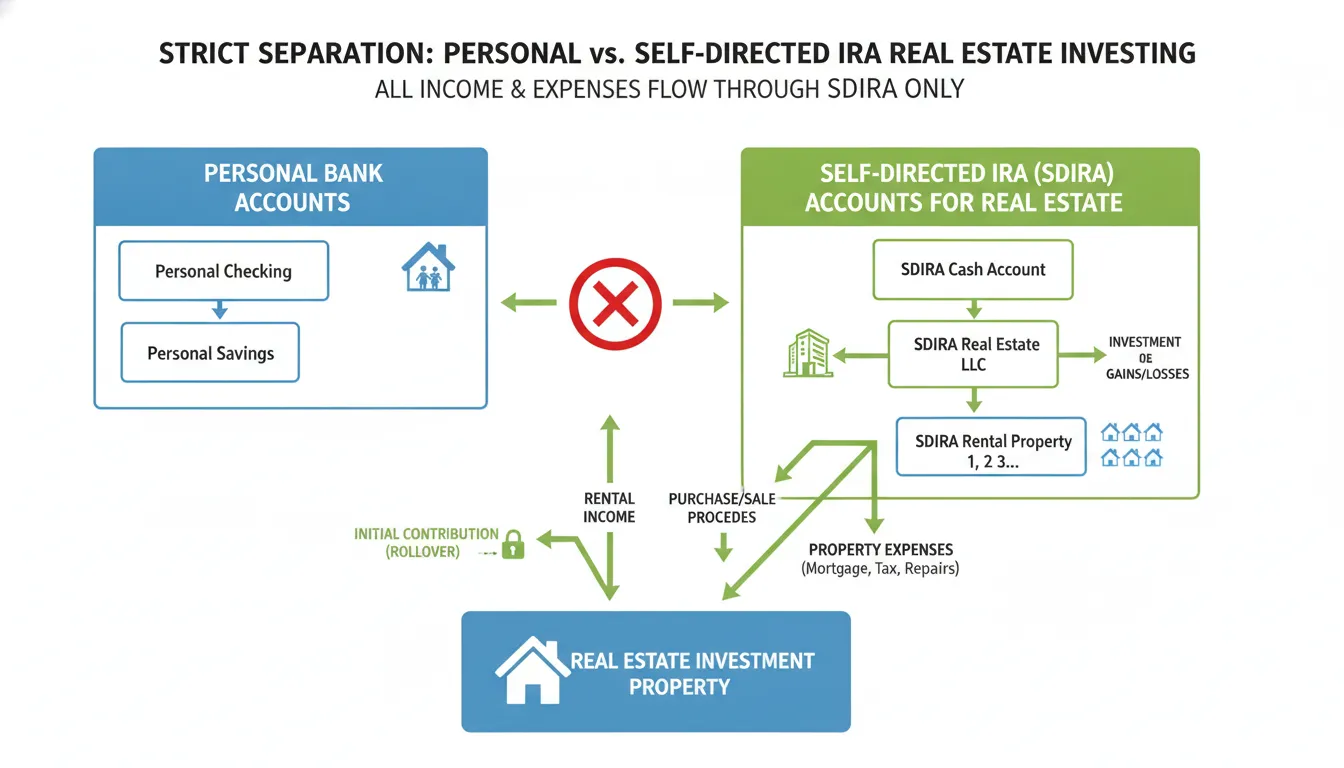
Managing a rental property inside a retirement plan requires a completely different mindset. For a standard rental, mixing funds might be a bad habit. But for a Self-Directed IRA, keeping your personal and retirement funds separate is a strict legal requirement. If you break these rules, the IRS can treat the entire account as a distribution, triggering immediate taxes and penalties.
Strict separation of funds
The main rule of bookkeeping for real estate investments in an IRA is the ban on commingling. You cannot use your own bank account to pay for a repair or a utility bill for the IRA-owned property. All money must stay inside the plan. According to guidelines on real estate IRA rules, mixing funds is a major compliance risk.
Income and expense flow
In a normal rental, you might collect rent and pay for a new heater with your own cash. With an SDIRA, this is not allowed. All rent must go directly to the IRA or its LLC. Every cost must come out of the IRA account, including taxes, insurance, and repairs. Using personal funds to cover a bill is seen as a loan to your plan, which is explicitly prohibited.
Every rental check and repair bill must flow directly through the IRA account to keep its tax status. Using personal funds for any IRA expense constitutes a prohibited transaction that can trigger full account disqualification.
Essential Bookkeeping Rules for SDIRA Real Estate
Building a reliable self directed ira real estate bookkeeping system requires clear, consistent rules. The IRS expects clean records for every cent that moves through your account. This is not just for your own peace of mind. You must demonstrate that each expense was for the asset and not for personal benefit. Good habits now will help you avoid costly tax risks later.
Categorize your property costs
When you buy a property in your IRA, group costs into three distinct categories. First, track the acquisition cost, including sales price and closing fees. Second, track capital improvements that add long-term value, such as a new roof or HVAC system. Third, log ongoing operating expenses to run the property. Keeping these separate helps you track your cost basis over time.
Using a clear rental property bookkeeping system helps you see exactly how much you have invested. Mixing these categories makes tax filing more difficult and can raise audit flags.
Log every rental expense
The IRS requires detailed records of all money spent to operate the rental. This includes property management fees, minor repairs, lawn care, painting, loan interest, property taxes, and insurance. Each line item tells a story about the property’s financial health.
- Property management fees and leasing commissions
- Repairs and routine maintenance costs
- Property taxes, insurance premiums, and HOA dues
- Interest on non-recourse loans used to acquire the property
- Professional services from CPAs, attorneys, and property inspectors
- Utilities and common-area maintenance expenses
It is vital to use accurate classifications. A repair is not the same as a capital improvement. One may be fully deductible in the current year while the other adjusts the property’s cost basis. Clear categorization is essential for proving income and expenses on your tax return.
Retain every proof of payment
A detailed ledger is only as strong as the supporting documents you keep. Save every receipt, invoice, and bank statement. These prove that funds came from the IRA and went to a legitimate vendor. Legal documents like deeds and contracts are also part of this file. If the IRS requests proof, you must show the complete path each dollar traveled. This audit trail is your best defense if your account is ever examined.
Store records for the full statute of limitations period, typically three to seven years after filing. Digital storage in a secure cloud system ensures documents remain organized and accessible. Maintain a separate digital folder for each property to streamline future tax preparation.
What Prohibited Transactions Must SDIRA Investors Avoid?
The IRS has strict rules governing how you use your IRA funds. A prohibited transaction is any improper use of your account assets by you or a disqualified person. If you violate these rules, the IRS may treat your entire account as a distribution, resulting in heavy taxes and penalties. Robust self directed ira real estate bookkeeping provides the audit trail needed to demonstrate every transaction was compliant.
Who is a disqualified person?
You cannot conduct business with certain individuals when using IRA funds. The IRS defines disqualified persons as the account owner, their spouse, ancestors, lineal descendants, and any entity these individuals control.
- The account owner and their spouse
- Parents, grandparents, and great-grandparents
- Children, grandchildren, and their spouses
- Any corporation, partnership, or trust in which a disqualified person holds a 50% or greater interest
- Any fiduciary or service provider to the IRA, including the custodian
According to the IRS, maintaining a current list of all disqualified persons and entities is a critical compliance practice. Verify each counterparty before signing any contract involving IRA assets.
Forbidden property transactions and uses
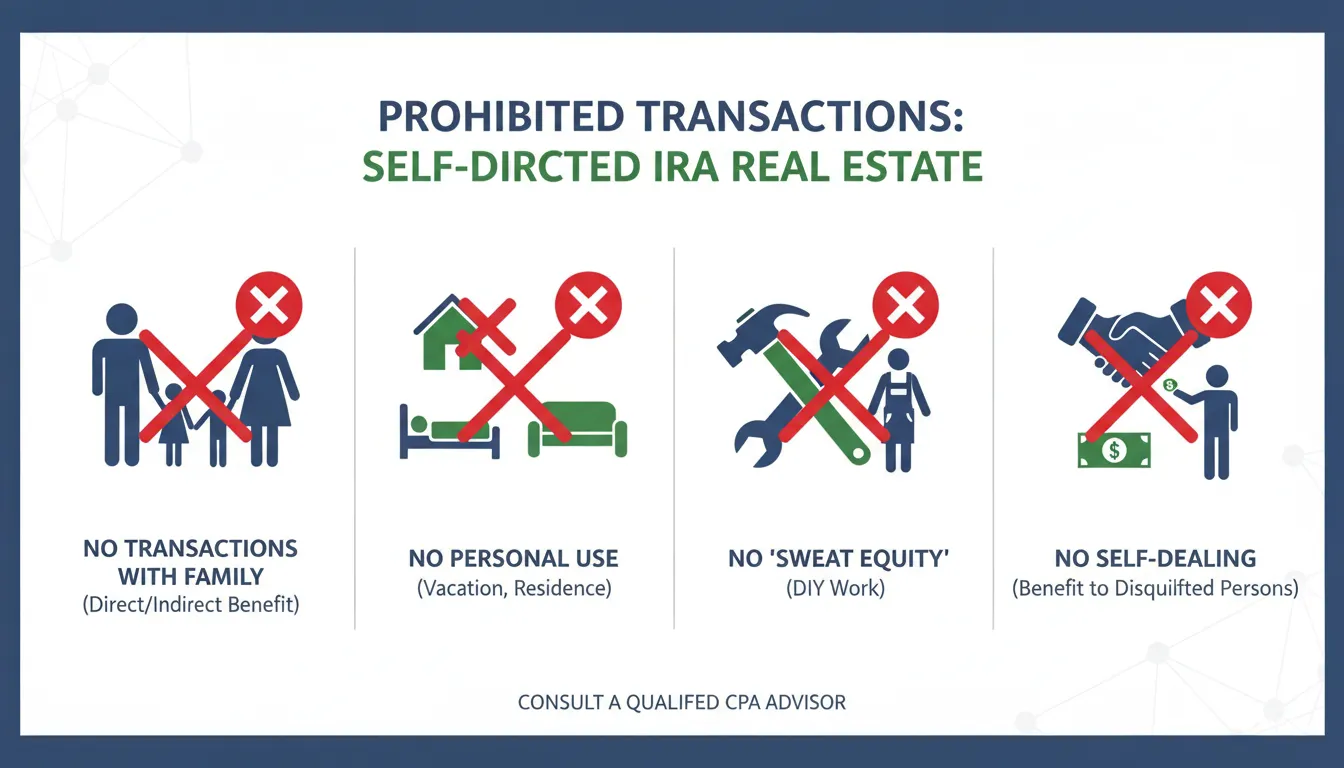
Real estate in an IRA must always be an arm’s-length transaction. The IRA must act as an independent entity separate from your personal life. You cannot sell a property you personally own to your IRA, and you cannot lease IRA-owned property to a disqualified person. For example, your adult child cannot live in a home owned by your IRA, even if they pay fair market rent. Following these tax strategies for real estate investors requires strict adherence to every rule. You cannot use the IRA property as a short-term office or vacation home for yourself.
Many investors use a Checkbook LLC to gain more control over their SDIRA. However, even with this structure, you must follow the same compliance rules. You cannot use the LLC bank account to pay personal bills. All income from the property must flow back into the IRA or the LLC account. Taking money out for personal use is a prohibited transaction. Maintaining clean bank statements for each property is the only reliable way to prove compliance and protect your retirement assets from IRS action.
The ban on sweat equity
A common mistake among real estate investors is performing labor on IRA-owned properties. The IRS prohibits sweat equity to prevent plan abuse. You cannot paint walls, fix plumbing, mow lawns, or perform any maintenance on the property. The law views this as providing services to the plan, which is not allowed. You must hire independent contractors who have no relationship to you or any disqualified person.
All work must be paid for using IRA funds. Using personal cash to buy paint or supplies for the rental constitutes a prohibited transaction, as it appears to be extending credit to the plan. Your bookkeeping should show a vendor invoice and IRA-funded payment for every repair. This documentation protects you if the IRS ever examines the property.
Record-Keeping Requirements and Building Audit Trails
Every transaction in a retirement account must have a clear paper trail. Strong bookkeeping for real estate investments proves that your account operates within federal rules. A systematic approach helps you avoid costly errors and protects the tax-advantaged status of your assets.
The IRS can audit your SDIRA at any time. A complete audit trail with receipts, bank statements, and transaction logs for every expense provides the evidence needed to confirm compliance and avoid account disqualification.
Building a clear audit trail
Maintain a detailed record for every single transaction. Each entry should document the date, amount, vendor, property, and business purpose of the expense. This process shows the IRS that you did not use funds for personal benefit. According to The Entrust Group, a clear audit trail is vital for surviving an official review. Every check or bank transfer must link to a specific invoice, lease agreement, or repair order.
- Keep separate bank accounts for each IRA-owned property
- Maintain digital copies of all leases, closing documents, and deeds
- Record every income deposit and expense payment within 48 hours
- Run monthly reconciliation reports matching bank statements to your ledger
- Store all documents in a secure cloud system with backup
- Conduct an annual full audit of each property’s books
Meeting federal record retention rules
Federal law requires you to keep records as long as they may be needed for tax administration. The IRS recommends retaining records for at least three years from the date you filed the return, though six to seven years is safer for real estate transactions involving depreciable assets or debt-financed income. Cloud-based document management ensures your records remain organized and accessible for the full retention period.
Understanding UDFI and UBIT Tax on SDIRA Real Estate
Most investors use a Self-Directed IRA to keep their gains tax-deferred or tax-free. However, if your IRA purchases property using leverage, you may owe tax on the debt-financed portion of your income. This is where Unrelated Debt-Financed Income (UDFI) rules apply. Accurate bookkeeping for real estate investments must capture which portions of your income are taxable when debt is involved.
Unrelated Debt-Financed Income basics
UDFI arises when your retirement plan uses a loan to acquire real estate. The IRS treats the portion of income attributable to debt as potentially taxable. You must separate your income between the cash-funded and debt-funded portions. Accurate records help you calculate the correct debt-to-equity ratio so you do not overpay or underpay your tax liability.
UBIT and Form 990-T filing requirements
Unrelated Business Income Tax (UBIT) is the tax imposed on debt-financed income earned within an otherwise tax-advantaged account. While most rental income and expenses are reported on Schedule E for individual investors, an IRA with UDFI must file Form 990-T. This separate return reports the IRA’s taxable income from debt-financed assets.
- Determine whether your loan triggers UDFI. If your SDIRA uses any debt to acquire property, including non-recourse loans, the income from that property is not fully tax-exempt. Calculate the average acquisition indebtedness for the tax year.
- Calculate the debt-financed percentage. The IRS looks at the ratio of average debt to the total adjusted basis of the property. If 60 percent of the property was acquired with debt, then 60 percent of the net income is subject to UBIT. Track this ratio annually as the loan balance declines.
- Track income and allocable expenses separately. Maintain rental records for all property expenses including fees, repairs, and taxes. These deductible expenses reduce the taxable UBIT amount. Allocate expenses based on the debt-financed percentage for accurate reporting.
- File Form 990-T by the deadline. If your IRA has $1,000 or more of gross unrelated business income from debt-financed property, you must file this form by the 15th day of the fourth month after the tax year ends. This is a separate return from your personal tax filing.
Accurate bookkeeping is essential for each of these steps. Errors in debt ratio calculations or missed filing deadlines can result in significant penalties. Many investors turn to tax planning for real estate investors to navigate these complex compliance requirements while protecting their retirement wealth.
Solo 401(k) vs SDIRA Real Estate: Key Bookkeeping Differences
Investors choosing between a Self-Directed IRA and a Solo 401(k) for real estate should understand the key bookkeeping and administrative differences. Both tools allow real estate investments with retirement funds, but they differ in control, fees, and filing requirements.
Checkbook control and asset access
A significant difference is how you access funds. A Solo 401(k) typically offers “checkbook control” by default, allowing you to write checks directly from the plan’s bank account. You do not need a custodian to approve every transaction. This saves time when urgent repairs arise. With a standard SDIRA, the custodian handles all payments. Many SDIRA owners establish a Checkbook LLC to gain more control, but even then, strict bookkeeping for real estate investments rules apply.
| Feature | Self-Directed IRA | Solo 401(k) |
|---|---|---|
| Personal loans from the plan | Not allowed | Allowed up to $50,000 |
| Annual administration fees | Often higher per asset | Usually lower or zero |
| Checkbook control | Requires LLC setup | Built-in feature |
| Custodian requirement | Required | Not required (owner-administered) |
| Tax filing obligation | Custodian files Form 5498 | Owner files Form 5500-EZ |
| Fund separation rules | Strictly enforced | Strictly enforced |
Core rules for both plans
Both plan types share the same fundamental compliance requirements for rental property bookkeeping. Every expense must be paid from the retirement account. All rental income must flow back into the same account. Using personal funds for a plan expense is a prohibited transaction under either structure. The IRS applies the same disqualified person rules and prohibited transaction definitions to both SDIRAs and Solo 401(k) plans.
Whether you choose an SDIRA or a Solo 401(k), professional accounting oversight is essential. The complexity of prohibited transaction rules, UDFI calculations, and multi-year record retention requirements makes specialized expertise invaluable for protecting your retirement assets.