

A portfolio can add doors faster than its accounting process can absorb them. Once that happens, one miscoded invoice or unreconciled rent deposit can distort every owner statement.
Property management accounting controls are repeatable checks that keep cash, expenses, and reports accurate as a portfolio grows. They include trust-account awareness, reconciled rent collections, consistent expense coding, documented approval workflows, reliable owner statements, and a disciplined monthly close. Each control should name who performs the task, who reviews it, what evidence is retained, and when exceptions must be resolved. Strong controls also separate payment initiation, approval, and bank reconciliation, a practice that CLA identifies as a fundamental safeguard. Together, these checks help investors spot errors sooner, protect owner funds, hold vendors accountable, and make portfolio decisions from dependable property-level data.
The central question is not whether more doors create more transactions; it is whether your review process scales with them. Why property management accounting controls matter as portfolios grow is the right starting point. The path begins with understanding where added volume creates financial risk.
Why property management accounting controls matter as portfolios grow
A small rental portfolio can often run on owner memory, a shared inbox, and a simple approval routine. As more properties, tenants, vendors, and team members enter the picture, those informal habits start to fail. Property management accounting controls replace memory with clear rules, records, and review points.
More doors create more points of failure
Growth adds transaction volume, but it also adds handoffs. One person may enter a vendor bill, another may approve it, and a third may send payment. Without set roles, duplicate bills, wrong property codes, missed rent, or unapproved work can pass through the books.
Property-level records are also vital once results become harder to see across the full portfolio. The U.S. Department of Housing and Urban Development describes project-based accounting as a system for tracking income and costs at the project level. For investors, that same view helps show which properties produce cash and which need attention.
Clear controls build owner confidence
Reliable controls create a traceable path from each transaction to each owner statement. That path should show who entered an item, who approved it, where it was coded, and when cash moved. Owners can then trust the reports without asking the accounting team to rebuild the story each month.
- Payment approvals help stop unauthorized or duplicate spending.
- Bank and rent reconciliations reveal missing cash or posting errors.
- Vendor records connect invoices with agreed prices and completed work.
- Access limits reduce the risk of improper changes to financial data.
These controls also support vendor accountability and fraud prevention. A manager should not control every step from invoice entry through payment and reconciliation. Separating those duties creates independent checks, while documented evidence makes unusual activity easier to review.
Faster close, clearer monthly decisions
Controls do more than protect cash. They make the monthly close faster because the team follows the same process for every property. Consistent coding, timely reconciliations, and defined review deadlines reduce cleanup work and keep portfolio reports comparable.
With clean reports, investors can act sooner on rising costs, weak collections, repair trends, and cash needs. They can compare asset performance without waiting for staff to explain unclear entries. This clarity supports better choices about budgets, vendors, reserves, and future acquisitions.
Investors who need a stronger control structure can review DMR Consulting Group’s property management accounting support. DMR helps connect property-level records with portfolio reporting, so owners receive useful financial data for each monthly decision.
Core property management accounting controls to document first
Property management accounting controls turn routine records into a repeatable review system. Start by naming the person who prepares each record, the person who approves it, and the deadline for review. Each control should state what evidence is saved and how exceptions are resolved.
Owner oversight and cash visibility
An owner statement review should compare reported income, expenses, cash, and reserve activity with the property’s books. The reviewer should note unexpected changes and require support before accepting the statement. At property level, consistent records help owners see which assets need attention.
The HUD project-based accounting guide supports collecting financial data at the project level for sound management decisions. Owners can apply that principle by requiring statements and supporting schedules for each asset. A portfolio summary should not hide property-level gaps.
Maintain a clear list of operating, deposit, reserve, and other bank accounts tied to each property. Document each account’s purpose, authorized users, statement recipient, and reconciliation owner. Trust-account and security-deposit rules can vary by location and lease terms. Confirm applicable requirements with qualified advisers, then reflect them in the control record.
Approval and transaction controls
Separate payment setup, approval, release, and bank reconciliation when staffing allows. Set approval thresholds and define who handles urgent payments or approver absences. Require the invoice, contract, and proof of work before approval. These steps give the owner a clear trail from request to cash movement.
Rent reconciliation should connect the rent roll, tenant ledger, deposits, bank activity, and general ledger. Investigate partial payments, concessions, returned payments, and timing differences before closing the month. A documented process also gives property management accounting services a consistent record to review.
| Control area | Risk reduced | Owner decision supported |
|---|---|---|
| Owner statement review. | Unsupported or missed activity. | Where to question results. |
| Bank and trust-account awareness. | Unclear cash ownership or access. | How to strengthen oversight. |
| Payment approval workflow. | Unauthorized or duplicate payments. | Who may approve spending. |
| Rent reconciliation. | Missing or misapplied receipts. | How to address collections. |
| Expense coding and vendor review. | Misstated costs or weak support. | Where costs need attention. |
| Monthly close checklist. | Late or inconsistent reporting. | Whether reports are decision-ready. |
Expense discipline and monthly close
Use a property-specific chart of accounts with plain coding rules for recurring costs, repairs, capital work, and shared expenses. Require a short note and supporting document for unusual entries. This structure makes comparisons more useful and reduces cleanup during portfolio management accounting.
Vendor controls should cover onboarding, tax forms, contract terms, insurance records when relevant, and changes to payment details. Verify bank-detail changes through a separate contact method before releasing funds. Review invoices against approved work and agreed pricing, then document any exception.
The monthly close checklist should assign deadlines for rent reconciliation, bank reconciliation, expense review, accruals, and owner reporting. It should also list required support and a final reviewer. Track unresolved items on an exception log rather than carrying them silently. This discipline helps owners know when reports are ready for decisions.
How should owner statements be reviewed each month?
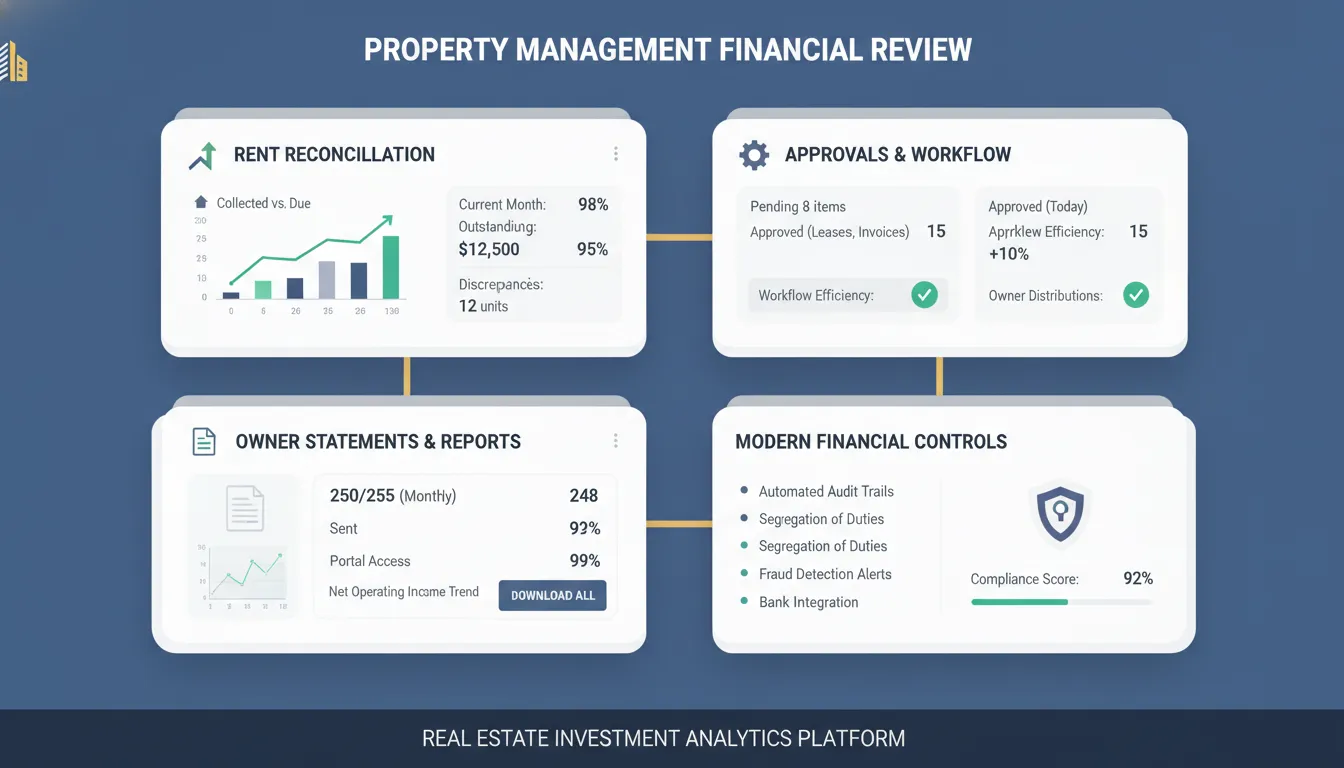
Review each owner statement in the same order every month: beginning cash, rent collected, fees charged, reserves, distributions, and ending cash. A consistent 40- to 60-minute review rhythm helps investors spot unusual entries, confirm support for charges, and keep questions tied to records rather than assumptions.
Reconcile the opening balance
Start by confirming that opening cash matches the prior month’s ending cash. If it does not, ask for a reconciliation that lists every adjustment and its source record.
Next, rebuild the month’s cash movement from the statement details. A documented monthly close process helps keep income and expenses in the right reporting period.
- Compare opening cash with the prior statement and bank reconciliation.
- Add rent and other cash collected during the month.
- Subtract fees, repairs, reserve transfers, and owner distributions.
- Confirm that the result equals ending cash.
Any mismatch is an exception that needs support. Ask whether the cause is timing, a bank transfer, a corrected entry, or an item posted to the wrong property.
Trace charges and collections
Compare rent charges with the rent roll and active lease terms. Then match collections to the tenant ledger, deposit detail, and bank activity. Ask why billed rent changed and whether unpaid balances moved as expected.
Review management fees against the agreement and the correct fee base. For repairs, compare each charge with its invoice, approval, property, and work description. Strong real estate investor bookkeeping makes this trace from statement to source record clear.
- Which tenants paid late, paid less, or did not pay?
- Do concessions, credits, and write-offs have clear support?
- Were repair bills approved and coded to the right unit?
- Does the management fee follow the signed agreement?
Do not spend equal time on every line. Focus on new vendors, round-dollar charges, duplicate amounts, sharp month-over-month changes, and entries without useful descriptions.
Test reserves, distributions, and ending cash
Review reserve activity separately from operating costs. Confirm that deposits and withdrawals follow the owner’s plan, and ask what future work each reserve balance is meant to fund.
Trace distributions to bank records and ownership instructions. Then compare ending cash with the bank reconciliation and expected reserve balance. If cash is lower than expected, ask which collection gap, repair, fee, or transfer explains it.
These steps turn statement review into a practical set of property management accounting controls. Track each exception, the person responsible, the due date, and the final support received.
Also compare open questions with prior months. Repeated issues may point to weak coding, late reconciliations, or missing review steps across the portfolio. That pattern matters more than a single corrected error.
How do approval workflows prevent leakage and confusion?
Approval workflows set a clear path from request to payment, then from payment to review. Each action has an owner, supporting records, and a time stamp. This structure limits duplicate bills, unapproved repairs, false vendors, and unclear owner distributions. It also helps teams find errors before they affect property reports or cash balances.
Clear rules for each transaction
Strong property management accounting controls define what needs approval, who can approve it, and which records must be attached. A written policy should cover routine bills, urgent repairs, staff reimbursements, new vendors, owner distributions, and journal entries. HUD guidance also supports documented financial workflows and payment authorization rules.
- Bills should match a contract, purchase order, or proof of service before approval.
- Repairs should show the property, scope, vendor quote, and approval limit.
- Reimbursements should include receipts, a business purpose, and the correct property code.
- New vendors should pass an independent review of tax forms, insurance, and bank details.
- Owner distributions should follow approved cash rules and current property reports.
- Journal entries should include support, a clear reason, and approval by someone outside the entry process.
These rules keep costs tied to the right asset and reporting period. That link matters as a portfolio grows across entities, accounts, and property teams. Sound portfolio management accounting gives owners a consistent view without hiding property-level issues.
Separate roles through permissions
The requester, approver, payer, and reconciler should not all be the same person. Software permissions can enforce that split even when the team is lean. A property manager may request a repair, while an asset manager approves it. Accounting can then release payment, and another team member can reconcile the bank account.
Permissions should also limit who can create vendors, change bank details, post journal entries, or approve owner distributions. Set approval limits by role and transaction type. Turn on alerts for edits made after approval. Keep the audit trail visible so reviewers can see who requested, changed, approved, and paid each item.
Controls for a growing portfolio
A small portfolio may use one approval level for routine work and a second level for larger repairs. As the portfolio grows, route requests by property, entity, budget, and dollar threshold. For example, a regional manager can approve common repairs within budget. Capital work or out-of-budget spending can move to the owner or CFO.
Growth also raises the risk of inconsistent coding and rushed reviews. Standard request forms reduce that drift. Monthly spot checks can test vendor changes, journal entries, reimbursements, and owner distributions. When workflows connect with real estate investor bookkeeping, each approval leaves support for the close and future review.
- Require a second approver when a payment exceeds the set limit.
- Block requesters from approving or paying their own requests.
- Send bank-detail changes to an independent reviewer before payment.
- Assign reconciliation to someone who cannot create or release payments.
Steps to reconcile rent collections without losing detail
A property-level control trail
Rent reconciliation should connect each tenant charge to a payment, bank deposit, and property ledger entry. This control trail keeps small differences from disappearing inside a portfolio total. It also supports property-level reporting because each amount stays tied to the right lease, unit, and asset.
Use one standard process for every property, but keep separate records for each asset. HUD guidance supports collecting financial data at the project level for property-specific analysis. Its project-based accounting guide also stresses clear workflows and a documented monthly close.
The rent reconciliation workflow
Complete the steps below on a set schedule, such as daily for cash matching and monthly before close. Assign one person to prepare the reconciliation and another to review exceptions. This split is a practical property management accounting control that reduces the risk of missed or unsupported changes.
- Set the expected rent baseline. Export the current rent roll by property, unit, tenant, and charge type. Confirm that new leases, renewals, move-outs, and rent changes agree with approved lease records. The total becomes the expected amount for the period.
- Match payments to tenant accounts. Compare received payments with the expected rent roll. Apply each payment to the right tenant, property, and charge. Keep partial payments and unpaid balances visible rather than netting them against other receipts.
- Tie receipts to processor batches. Match online payments, checks, and other receipts to the related payment processor batch or deposit log. Record batch dates, gross receipts, fees, and net transfers separately. This detail explains why a bank deposit may differ from tenant payments.
- Match batches to bank deposits. Trace every processor transfer and deposit log entry to the bank statement. Investigate missing, duplicate, delayed, or split deposits. Do not clear a batch until its amount and timing have support.
- Resolve unapplied cash. Place receipts without a clear tenant match in an unapplied cash account. Research payer names, reference numbers, amounts, and property records. Move the cash only after support shows where it belongs.
- Validate adjustments. Review concessions, late fees, reversals, refunds, and write-offs against leases and approval records. Post each item with a reason code and property tag. This keeps normal collections separate from decisions that change reported revenue.
- Document and assign exceptions. List every open difference with its property, amount, owner, cause, and due date. Carry unresolved items forward without hiding them. Require reviewer sign-off once deposits, adjustments, and outstanding balances agree.
From exceptions to portfolio insight
The completed reconciliation should feed both property reports and the portfolio dashboard. Show expected rent, collected rent, unpaid balances, unapplied cash, concessions, fees, write-offs, and open deposit exceptions by asset. A consistent view makes weak collection patterns easier to spot without losing tenant-level support.
Keep the detailed schedule with the monthly close package, then compare trends across assets. DMR’s guide to portfolio management accounting explains why property-level detail matters within a wider portfolio view. Dashboard totals should always trace back to approved reconciliation records.
Build expense coding rules that support portfolio decisions
A shared chart of accounts
Expense coding should produce reports that help owners compare assets and make sound portfolio decisions. Start with one chart of accounts for the full portfolio. Define each account in plain language, then give staff examples of costs that belong there.
Keep account names and uses consistent across every property. If one team codes plumbing work as repairs while another uses maintenance, a portfolio comparison can mislead. DMR’s accounting and CPA services can help investors shape a chart around useful property-level reporting.
- Use distinct accounts for major cost groups, such as utilities, repairs, insurance, and management fees.
- Tag every transaction to the right property and unit when unit-level detail will guide a decision.
- Write short coding notes for costs that staff often confuse.
- Limit new account creation to an approved person or role.
Clear cost tags and records
Property and unit tags show where cash was spent, while the account code explains why. This detail helps owners spot repeat issues and compare similar units. A federal housing guide also supports collecting financial data at the project level for property-specific analysis.
The same guide treats proper cost allocation as a core part of project-based accounting. Its project-based accounting guidance gives a useful basis for setting written allocation rules. Those rules should explain how staff split shared costs among properties.
Create a high-level rule for repairs versus capital costs, but do not ask staff to make tax calls alone. The rule can flag items based on the work done, expected benefit, and supporting invoice. Send unclear or material items to the right accounting or tax adviser before the books close.
Consistent vendor names matter too. Choose one approved name for each vendor and merge likely duplicates. Attach the invoice, property tag, work description, approval, and payment record to each entry. These records make later review faster and preserve the reason behind the code.
A routine exception review
Review uncategorized transactions on a set schedule before monthly reports go to owners. Assign each exception to a named person and set a due date. The reviewer should also scan suspense accounts, duplicate vendors, missing property tags, and unusual shifts between cost groups.
Do not clear an exception by choosing the closest account without support. Check the source record and ask what decision the final report must support. Strong real estate investor bookkeeping keeps the audit trail intact while turning raw spending into useful portfolio insight.
Track repeat coding errors by source, property, and vendor. A pattern may point to unclear rules, weak training, or a software setup issue. Update the coding guide when the review reveals a gap, then share the change with every person who enters or approves costs.
Monthly close discipline turns controls into useful reports
A control only matters when it produces reliable information on time. A disciplined monthly close converts daily transactions into reports owners can use. It also exposes missing entries, stale balances, and unusual results before they become harder to explain. Strong property management accounting controls make that routine repeatable across every property.
A close calendar with clear owners
The close calendar should assign each task, owner, due date, reviewer, and proof of completion. It should cover rent posting, accounts payable, accruals, journal entries, and bank reconciliations. Documented workflows matter because financial policies should define the monthly closing process and payment rules.
Set a firm lock date for owner statements after the core checks are complete. Late invoices and corrections should follow a set exception process, not quietly change a closed period. This discipline creates a clear record of what changed, who approved it, and why.
- Reconcile operating, security deposit, and reserve accounts to bank activity.
- Match rent receipts and tenant balances to the rent roll.
- Review unpaid bills, open receivables, accruals, deposits, and uncleared items.
- Confirm that income and costs are coded to the right property and period.
Variance review and open items
A completed reconciliation does not prove that the results make sense. The close team should compare actual results with budgets, prior periods, and property-level trends. Material variances need a plain explanation, a named owner, and a due date for follow-up.
Keep unresolved issues on one open items list instead of burying them in emails. Include the amount, property, cause, next action, and expected resolution date. This approach supports sound portfolio management accounting because owners can separate one-time timing issues from operating trends.
The list should also show whether an item affects cash, net operating income, owner distributions, or compliance. That detail helps management rank issues by risk. It also stops the same reconciling item from rolling forward month after month without review.
Dashboard updates and management review
After the ledger is locked, refresh the dashboard from the approved close data. Useful views may show cash, collections, payables, budget variances, occupancy, and property-level results. A cloud-based workflow reduces manual handoffs while keeping source records, review notes, and approvals tied to each close task.
Technology can flag exceptions, but management must still challenge the story behind the numbers. Reviewers should ask whether results match operating conditions and whether open items could change an owner decision. DMR’s process-driven accounting and CPA services pair structured review with cloud-based reporting for clearer portfolio oversight.
The final review should record approval, needed corrections, and questions for the property team. That record turns the close into a control trail. It also gives the next month’s team a clear starting point rather than forcing them to rebuild context.
When should investors bring in accounting support?
Investors should bring in accounting support when routine reporting no longer gives owners clear, timely answers. Warning signs include repeated cash differences, delayed closes, inconsistent owner statement formats, unclear approval trails, and expanding entities or properties. Waiting until tax season usually turns operational control gaps into cleanup projects.
Specialized support is useful when an investor adds properties, entities, lenders, or operating partners. DMR Consulting Group works with real estate investors and can help build consistent close routines, review controls, and portfolio-level reporting. Its Accounting and CPA Services focus on the financial needs of real estate portfolios rather than generic small-business bookkeeping.
Frequently Asked Questions
What are the core internal controls for property management?
Core property management accounting controls include separating financial duties, requiring two payment approvals, reconciling bank accounts, and reviewing owner statements before release. Teams should also restrict system access, document close procedures, and investigate unusual transactions. According to CLA, these controls reduce financial risk, deter fraud, support vendor accountability, and strengthen operational discipline.
How can property managers segregate duties effectively?
Assign payment initiation, approval, bookkeeping, and bank reconciliation to different people whenever staffing allows. In a smaller operation, software permissions can prevent one person from completing every step. An owner or executive should independently review bank activity, payment support, and reconciliation exceptions. Access should also be reviewed periodically so former or reassigned employees cannot change sensitive financial records.
What should be included in a property management financial policy?
A property management financial policy should define bank and trust-account handling, payment approval thresholds, vendor onboarding, expense coding, and rent reconciliation. It should also cover owner statement review, close deadlines, responsible staff, and the process for resolving exceptions. The HUD project-based accounting guidebook also emphasizes documented workflows, payment authorization requirements, and close procedures.
How can property managers improve rent collection reconciliation?
Reconcile rent collections by matching the rent roll, tenant ledger, payment processor report, deposit record, and bank activity for the same period. Investigate partial payments, returned payments, unapplied cash, concessions, and deposits recorded at the wrong property. Complete this review on a set schedule, document every adjustment, and require an independent reviewer to approve unresolved differences before owner statements are issued.
How do you conduct a surprise internal audit for property management?
Select a sample of recent journal entries, bank reconciliations, vendor payments, petty cash activity, security deposits, and vacant-unit records without advance notice. Verify supporting documents, approvals, account coding, and bank activity. CLA notes that randomized reviews can deter misconduct and reveal how employees follow procedures when they do not expect an immediate review.
Ready to Strengthen Your Accounting Controls?
Weak controls become harder to correct as your portfolio adds doors, transactions, vendors, and reporting demands. Delayed reconciliations and unclear approvals can leave your team chasing errors after owner statements are due. Starting now gives you time to standardize workflows, clarify accountability, and build a monthly close process that supports confident decisions.
DMR Consulting Group can help you assess owner statements, rent collection reconciliation, expense coding, approval workflows, and trust-account practices across your operation. A focused review can show where controls break down and help your team set practical priorities for stronger reporting. Ready to create a more disciplined accounting process?