
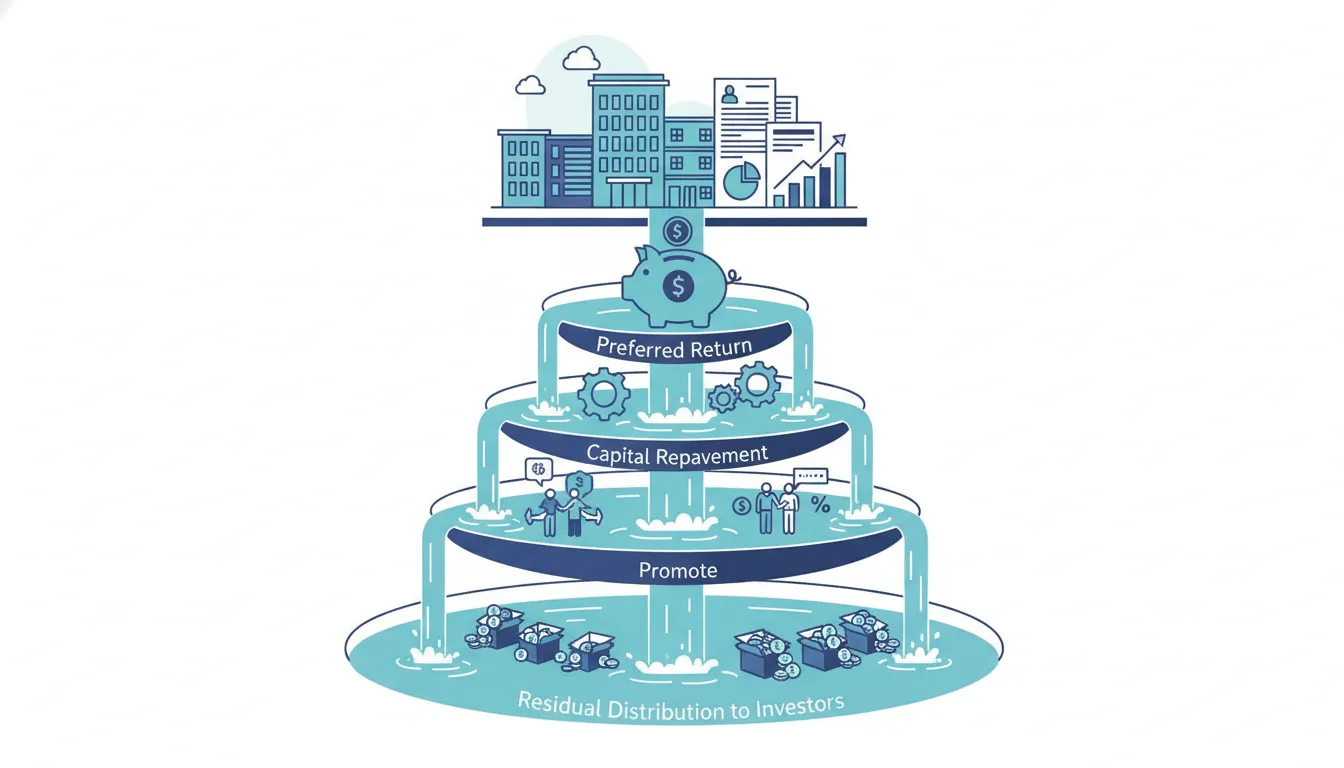
When a real estate syndication closes a sale or has cash available to distribute, the operating agreement determines who gets paid, how much, and in what order. A clear accounting process turns those complex rules into precise, supportable payments.
Schedule a consultation for accurate syndication waterfall accounting and investor reporting.
Waterfall distribution accounting real estate is the process of tracking and splitting investment profits based on a specific set of rules. For syndicates and investment pools, this calculation is a fundamental part of fund administration accounting. According to industry data, an 8% preferred return is the industry standard for about 67% of funds. Professional accounting helps leaders calculate these complex splits. It also provides the clear reports needed to keep investors happy and avoid legal fights.
Understanding how these funds move through each level is vital for any real estate operator. You need to know the rules that govern your investment payouts. We will start with the core question.
Waterfall Distribution Accounting Real Estate: What is waterfall distribution accounting in real estate?
In real estate, a waterfall distribution is a set of rules for how to share profits. It tells you the order in which money goes to the people who put in cash and the people who run the deal. This method acts like a map for every dollar that comes in from rent, sales, or debt changes. For syndicators, using clear syndication accounting reports is key to tracking these payments. A good waterfall makes sure that both partners know fully when and how they will get paid.
How the waterfall split works
Most real estate deals involve two main groups: limited partners (LPs) and general partners (GPs). The waterfall defines how these groups split the cash that the property makes. Usually, the LPs get their first cash back first along with a small profit. This first layer is often called a preferred return. Many funds set this return at 8% as a common goal for their people. Once the LPs have their money, the rest of the profit starts to flow to the GP through a split known as carried interest. Proper real estate syndication accounting services help manage these tiers to keep everyone on the same page.
How tiers drive payments
Waterfalls use layers or tiers to decide the order of payments. Each tier must be filled before money moves to the next one. For example, a deal might pay out all capital first, then a catch-up profit, and finally a split of the left over gains. Some models use the internal rate of return (IRR) to set these hurdles. Large groups often look to the ILPA model agreement for standard rules on how to build these fund levels. These agreements help make sure that the math stays the same for every payout event like a sale or a loan change.
The role of the operating agreement
The rules for your waterfall live in your legal papers. This is usually the operating agreement or the limited partnership agreement. These papers are more than just a short note; they are the legal guide for how the money must move. Errors in reading these papers can lead to big fights between partners. A clear guide to distribution waterfalls can help you see why the exact wording matters. You should fix any points that are not clear before you make the first payment to your investors.
Why accounting records matter
Waterfall accounting can get hard due to things like compounding interest and extra payments. You need to keep clear books for every property and entity, which is why professional syndication accounting is critical.
How do the main waterfall tiers work?
The main waterfall tiers generally pay in this order:
- Return investor capital.
- Pay the preferred return.
- Apply any sponsor catch-up.
- Split remaining profit under the promote or carried-interest tier.
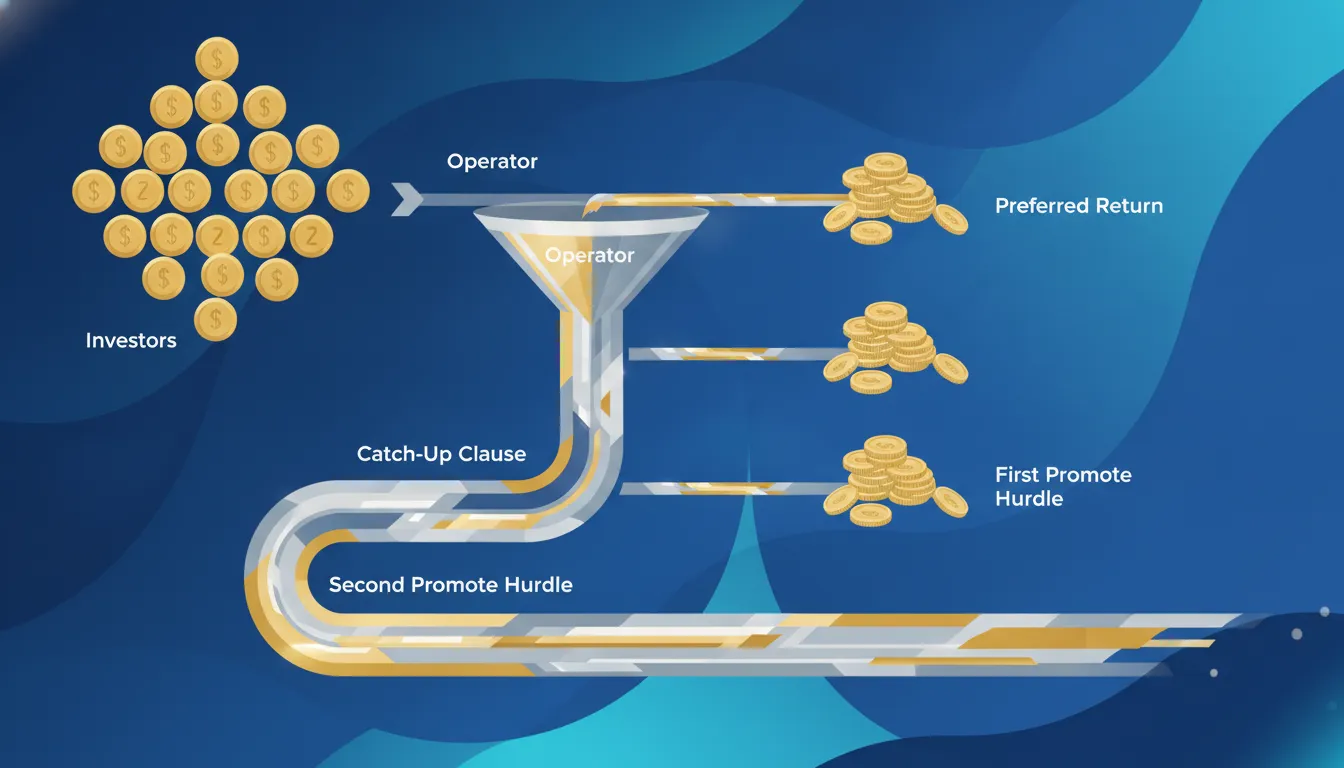
A real estate waterfall is a set of rules for how a deal pays out. It works like a chain of steps. Money flows through these steps in a set order. This order makes sure that each person gets their share at the right time. Most deals use real estate syndication accounting services to track these flows. These steps are often called tiers. Each tier has a hurdle that must be met before money moves to the next one. This setup helps keep the goals of the sponsor and the investors in sync.
The start of the flow: preferred returns
The first tier usually focuses on the investors. This is where the preferred return lives. It is a set rate that investors must get before the sponsor takes any profit. Industry data shows an 8% preferred return is the standard for 67% of funds. Many deals pay back capital at this stage. This means investors get their cash and a small profit first. It lowers the risk for the people putting up the funds. It sets a clear bar for the sponsor to clear.
Some deals use a compounded return. If a deal does not pay out one year, the debt grows. Most waterfalls use this compounded hurdle. This method rewards investors for the time their money is in the deal. It makes sure they get a fair return even if cash flow is slow at the start. Sponsors must manage the deal well to reach their profit tiers. Correct math is key here to avoid future fights over the numbers.
Reaching the catch-up and promote tiers
Once the preferred return is paid, the sponsor gets a turn. This tier is called the catch-up. It lets the sponsor get a share of the profit that matches their agreed split. If the final split is 80/20, the catch-up helps the sponsor hit that 20% mark. It fills the gap between the preferred return and the final profit split. This tier is a key part of the deal for the sponsor. It pays them for the work of finding and running the asset. Without it, the sponsor might not get paid for their effort.
The final tiers are where the promote or carried interest kicks in. This is a profit share that goes to the sponsor. It usually happens after all hurdles are met. Market data says that 20% carried interest is the norm for most funds. This part of the waterfall rewards the sponsor for good results. The better the deal does, the more the sponsor can earn. It aligns the interests of both parties by focusing on total returns. It also gives the sponsor a reason to drive high value.
Choosing between American and European models
There are two main ways to set up these tiers. The American model looks at properties one by one. If one asset sells for a profit, the waterfall runs for that deal. This is common in deals with many properties. It allows sponsors to get paid sooner. The European model is different. It looks at the whole fund. Investors must get all their cash back from all properties before the sponsor gets a promote. Detailed models from groups like ILPA often outline these fund-wide rules.
| Feature | American Model | European Model |
|---|---|---|
| Calculation Basis | Per individual asset | Total fund performance |
| Capital Return | Asset by asset | All capital first |
| Payment Timing | Faster for sponsors | Slower for sponsors |
| Investor Risk | Higher | Lower |
| Common Use | Deal-by-deal syndications | Private equity funds |
Picking a model is a big choice for any sponsor. The American style keeps sponsors eager with early wins. The European style builds trust with investors. Both need very careful math to work well. Mistakes in these sums can lead to tax issues or legal rows. Working with a pro ensures your records are clear and right. This keeps the deal on track for years to come.
A simple real estate waterfall distribution example
Real estate investors use waterfalls to split deal profits. These rules live in the partnership agreement. They show who gets paid and when. In a simple deal, you might see a single hurdle before the sponsor gets a share. This helps keep everyone aligned on the deal goals and keeps the math clear for all parties.
How the distribution flows
Let’s look at a $1 million investment from an investor. We will assume the deal makes $1.4 million in cash to be paid out. This money could come from rent or a property sale. The money flows through steps based on the priority sequence in the deal papers. This example shows how waterfall distribution accounting real estate works in a basic setting.
Breaking down the three tiers
The money moves through the tiers in a set order. This ensures the investors get their base return before the sponsor takes a profit share. In many cases, an 8% return is the standard for most funds. Following a clear model helps the team create syndication accounting reports that build trust with all partners. It also makes sure the sponsor gets their fair share for managing the asset.
- Return of Capital. The first $1 million goes to the investors. This pays back their full first stake in the deal.
- Preferred Return. The investors get a set 8% return on their money. In this case, that means they get $80,000.
- Residual Split. After the first two steps, $320,000 is left. If the split is 80/20, the investors get $256,000 and the sponsor gets $64,000.
The sponsor share is the reward for finding and running the deal. In our example, the 20% split only starts after the investors get their money back and their 8% return. This structure is common in the industry. It keeps the sponsor focused on making the deal a success. Many funds use a 20% split as a market norm for these profit shares.
Why exact accounting matters
Exact records are key for these deals. Small errors in the math can lead to big fights later. These rules are binding and must be run at every cash event. Our team at DMR Consulting Group provides real estate syndication accounting services to help you track these flows with ease. You can also find more details on partnership rules at IRS.gov to see how the law views these payments.
What records support accurate waterfall calculations?
Clean waterfall distribution accounting real estate starts with good data. Real estate leads must track every dollar that flows in and out of a deal. Without the right records, you risk making errors that upset your partners. These records prove how you figure each payout. They also help you stay in line with your legal deals. Handling these papers well builds trust with your peers and keeps your deal on track.
Core legal agreements
The base of any waterfall model is the legal paper for the deal. This is usually the operating agreement or the limited partnership agreement. These papers set the rules for how you share profits. They tell you who gets paid first and what goals you must hit. According to industry experts, ambiguity in a waterfall often leads to future disputes between sponsors and investors. You should review these rules before you run any math.
You also need to keep track of any changes to these main rules. Sometimes partners sign new letters or update the main contract. These changes can shift how much each person gets from the deal. A fund lead relies on these rules at every payout event. This includes events like a home sale or a loan change. Keeping these papers in one place ensures your math matches the law. It also makes it easier to show the numbers to your partners later.
Cash account handling
You must keep detailed logs of all capital accounts. This includes the first funds each partner put into the deal. It also tracks the current total of their stakes. You need to record the exact date of every cash payment. This is vital because many payouts use time-based rules. For example, some returns grow over time based on when the money was sent. You should also track any return of funds that has already happened. This helps you know the exact balance for each person at any time.
Daily cash records are also needed for a full audit trail. You must show the deal-level cash flow for each month. This helps you prove that you have enough cash to make a payout. It also helps you track things like unpaid returns. If you do not pay the full amount one month, that balance usually rolls over. Tracking these unpaid amounts ensures that your future payouts are correct. Clear records of every bank move provide the proof your peers want to see. This level of detail keeps everyone on the same page.
Logs and approvals
A strong audit trail shows the history of every choice. This includes the written ok for each payout. You should save emails or signed notes that show why a payment was made. You also need to track ownership changes over the life of the deal. If a person sells their stake, your records must show who owns it now. This ensures the right person gets the check at the end of the month. It also prevents legal issues when the deal finally closes.
Using the right tools helps you keep these records straight. Many leads use special software to handle these tasks. These systems track goals, profit splits, and catch-up rules with ease. They provide a clear view of how you reached each total. This openness is key to a good bond with your partners. Professional model agreements often suggest keeping these detailed logs to prevent mistakes. Good record keeping protects your name as a reliable real estate lead.
Common waterfall accounting mistakes and controls
Operators can reduce waterfall errors by reconciling capital accounts, confirming hurdle dates and compounding rules, documenting approvals, and independently reviewing the calculation before cash is released.

Managing a complex payout model is hard. Small errors in your waterfall distribution accounting real estate workflow can lead to big cash gaps. Without strong checks, these slips can hurt investor trust and lead to legal fights. Using real estate syndication accounting services can help you find these flaws before they cause harm.
Avoid misreading your agreement
The most common error is failing to follow the legal document exactly. Many sponsors rely on what is common in the market rather than what their own deal says. Vague terms in these papers often lead to future fights between partners. It is key to fix any unclear terms before you make the first payment to your investors.
You must treat the waterfall as a legal rule for every cash event. This includes rent, home sales, and loan re-funding. A 2020 report from the Institutional Limited Partners Association provides model terms to help clear up these roles. Always check that your math matches the exact words in your signed pact.
Watch for compounding and date errors
Preferred returns are a major source of book slips. Data shows that over 78% of fund models use preferred return hurdles with compounding interest. If you miss just one month of interest, the final payout to your partners will be wrong. Using poor dates for cash events can also skew the final rate of gain.
Another risk is mixing up cash payments with tax splits. These are not the same thing. One tracks the check you write, while the other tracks tax debt. Mixing them can lead to wrong syndication accounting reports and issues with the IRS. Keep these books apart to ensure your records stay clean and clear.
Set up strong internal controls
To stop errors, you need a system of checks and balances. Do not rely on one person to manage your file. Version control is key when many people touch the same sheet. One wrong cell rule can change every payout in the stack. We suggest a full check of every cash event by a second pair of eyes.
Testing is also a great tool for risk control. Run your model with different sale prices or hold times to see if the math breaks. High-quality capital call accounting ensures that your cash records are always ready for a check. These steps build a strong frame for your reports and keep your investors happy.
How should operators calculate and report distributions?
Handling real estate syndication accounting services needs a clear path for payouts. Owners must follow a set way to find and share profits with investors. This workflow ensures that every dollar follows the rules set in the deal papers. Using a standard system helps avoid errors and builds trust with your partners.
Steps for accurate math
The first step in waterfall distribution accounting real estate is to gather all property data. You must track cash flow, asset sales, and loan payouts. Most funds use a preferred return hurdle, which is often set at 8 percent. About 78 percent of funds also use compounded returns for these hurdles. You should run these numbers through your accounting tools to keep things exact.
Once you meet the first hurdle, you must find the sponsor’s share. This part of the deal is often called the promote or carried interest. Market data shows that a 20 percent carry is a common norm for most funds. You need to check that your math matches the tiers in your limited partnership deal. High-quality model deals from trade groups show how these steps should look in practice.
The review and sign off process
After you run the math, you need a second set of eyes. A CFO or lead accountant should check the work before any cash moves. This review catches small slips that could lead to big disputes later. You should match the final payout totals against your bank balances to ensure you have enough cash on hand. This step protects both the sponsor and the limited partners.
Sign off should be recorded in writing. The lead owner must sign the final distribution report. This record shows that you followed the proper rules for the fund. Once ready, you can start the bank transfers. Make sure to keep a log of each payment to help with later checks and tax filings.
Investor reporting and tax prep
Sharing the results with your partners is vital. You should provide clear syndication accounting reports that show how you reached each figure. These reports should break down the return of capital, the preferred return, and any profit splits. This level of detail keeps investors happy and ready for the next deal.
Good reporting also makes tax time easier. Clean distribution logs are the base for K-1 forms. When your books are right, your CPA can file tax returns on time without a rush. This prep helps you avoid late fees and ensures that your investors get their tax papers when they need them.
When does a syndication need accounting or CFO support?
Managing a real estate syndication starts with clear rules. But as you add more partners and tiers, the math gets hard. You must track every dollar with care to keep investors happy. A real estate syndication accounting services team helps when the waterfall model moves past a simple split.
Handling Tiered Distributions
Many funds use complex tiers to reward work. You might have a preferred return followed by a catch-up phase and then a promote. Data shows that more than 78% of fund waterfalls use a preferred return hurdle that compounds over time. An 8% preferred return is the standard for about 67% of funds today.
Tracking these tiers in a spreadsheet often leads to errors and disputes. Mistakes in waterfall distribution accounting real estate can lead to big legal fights with your partners. If you have many hurdles, you need a pro to run the numbers. They ensure you follow the exact language in your agreement. This math must be right every time you pay out cash from rent or a sale.
Payout Events and Rules
A waterfall is a legal rule used at every payout event. This includes monthly cash flow, property sales, and refinancing proceeds. Each event might have different rules for how you split the money. About 71% of surveyed funds still use 20% carried interest as the market norm. A pro team helps you track these events to keep your records clean.
Math gets even more complex with interim payments and compounding interest. You need to account for how these payments affect future splits. A fractional CFO can walk you through the math to show how every dollar is moved. This level of detail is needed for fair distributions across your whole fund. It keeps you in line with your partners and the law.
Building Trust and Scale
Investors want to see clear data about their returns. They need to know their money is safe and the math is fair. A fractional CFO adds a layer of trust to your team. They review the syndication accounting reports before you send them out. This shows you take your duty to them with care and value their trust.
When you raise capital, you must show how you handle money. Clear records help you get more funding later. It also helps during audits or if a partner has a question. Having a pro on your side makes these tasks easier and faster. It ensures that your fund grows on a strong base of data and trust.
Growth brings new problems to your fund. You might buy more assets or change how you split profits in a new deal. Each new asset can have its own set of rules. A pro team frees up your time so you can focus on finding new deals. It also gives you better data to make big choices and grow your real estate business safely.
Frequently Asked Questions
What is waterfall distribution in real estate?
A distribution waterfall is a cascading sequence of payments that shows how a real estate deal shares profits. This legal rule dictates who receives money first and how every dollar is split between sponsors and investors. According to Crowdfund Lawyer, these rules are written into the legal documents. This helps each party get paid the right amount during events like property sales or refinancing.
What is the waterfall method of accounting?
Waterfall accounting is the process of tracking and calculating payouts based on specific goals defined in a partnership agreement. Instead of using common market norms, fund managers must follow the exact legal language of the signed document. This method handles hard tasks like compounding interest and interim payments. Proper accounting is vital at every stage, including cash flow from operations, asset sales, and refinancing. This keeps all partners in agreement and helps to prevent future legal fights.
What is a preferred return hurdle in real estate?
A preferred return is a set profit level that investors must receive before the deal sponsor begins to share in the remaining gains. Industry data shows that more than 78% of fund waterfalls use a preferred return hurdle that is worked out on a compounded basis. Most real estate funds set this rate at about 8%. Once investors get this amount, the payout moves to the next tier, such as catch-up rules or profit splits.
What is the difference between American and European waterfalls?
American waterfalls calculate payouts on a deal-by-deal basis, allowing sponsors to get paid as each property is sold. In contrast, European waterfalls use a whole-of-fund path where investors must receive all their capital and returns before the sponsor gets any profit sharing. According to Wall Street Prep, the European model is better for the investor because it delays the sponsor’s share until the entire fund is profitable. Most US real estate groups favor the deal-by-deal American structure.
Ready to strengthen your syndication accounting?
A reliable waterfall process gives operators clearer distribution support, a stronger audit trail, and more consistent investor reporting. DMR Consulting Group combines real estate investor experience with data-driven accounting and CFO guidance. Our real estate syndication accounting services can help your team build repeatable processes around capital activity, waterfall calculations, and reporting.
Ready to schedule a consultation? Contact our team to discuss your syndication accounting needs.